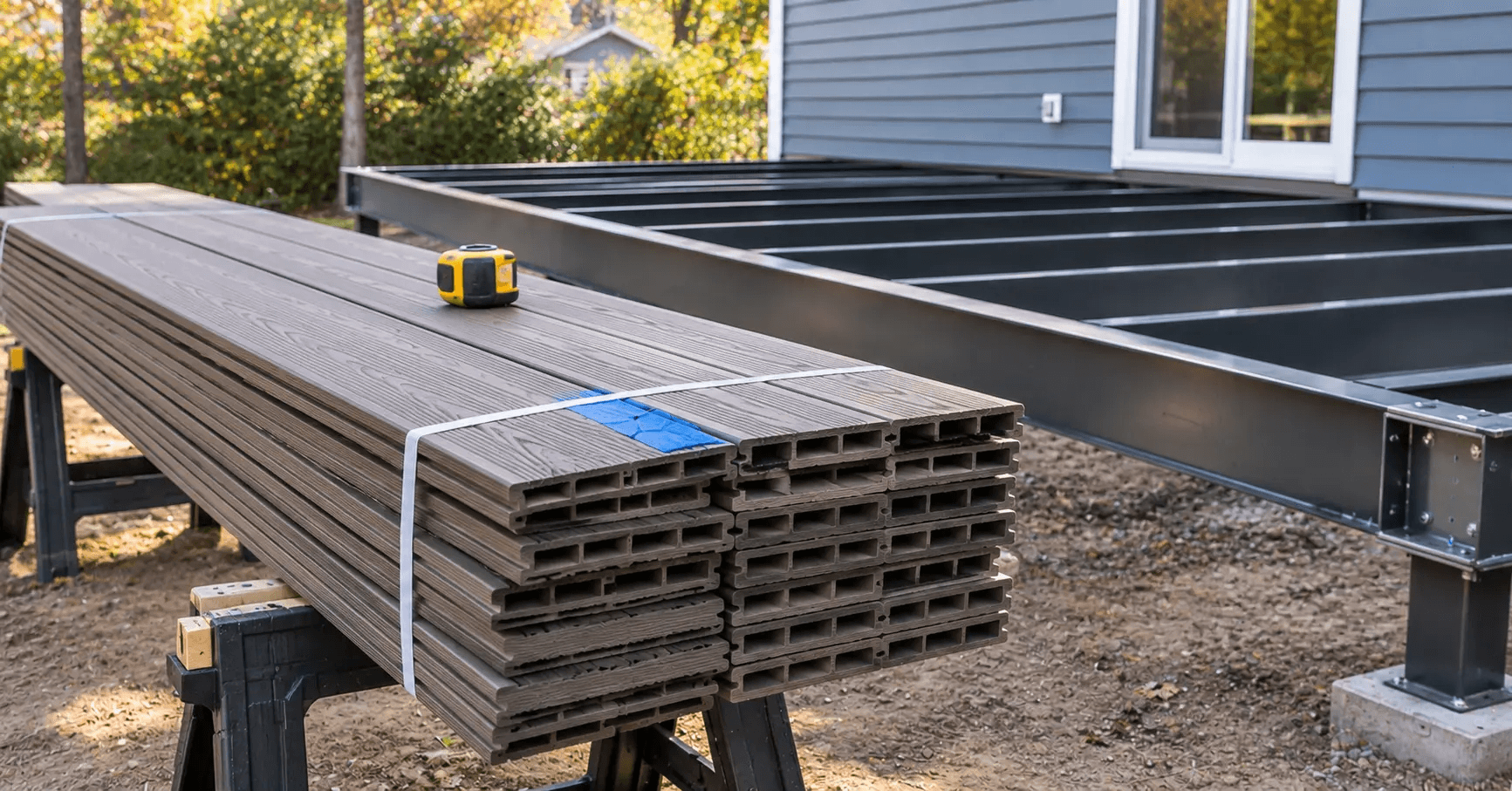
Deck boards are the easiest part of a deck to count and still the part people come up short on. They count the boards across the deck and forget the waste, the butt joints, the picture frame, and the stairs.
Here is how to count them so the order is right the first time.
The basic count
Decide which way the boards run. On most decks they run parallel to the house, across the joists.
Measure the distance the boards have to cover, which is the dimension at a right angle to the way they run. Convert it to inches, then divide by the width of one board plus one gap.
Nominal 5/4x6 decking, wood or composite, is about 5.5 inches actual. With a 3/16 inch gap, each board covers about 5.69 inches.
A deck 12 feet out from the house is 144 inches. 144 divided by 5.69 is 25.3, so you need 26 boards. If the deck runs 16 feet along the house, those are 26 sixteen footers.
Chart for common deck sizes
Boards running the long way, 5.5 inch boards, joists at 16 inches on center:
| Deck size | Boards needed | Board length | With 10% waste | With 15% waste | Screws |
|---|---|---|---|---|---|
| 10 x 10 | 22 | 10 ft | 25 | 26 | About 400 |
| 12 x 12 | 26 | 12 ft | 29 | 30 | About 520 |
| 12 x 16 | 26 | 16 ft | 29 | 30 | About 680 |
| 14 x 20 | 30 | 20 ft | 33 | 35 | About 960 |
| 16 x 20 | 34 | 20 ft | 38 | 40 | About 1,090 |
The first number in each size is the width the boards cover. A 12 x 16 means boards running 16 feet, covering 12 feet.
The gap barely changes the count
Butting wet treated boards tight versus leaving a 3/16 inch gap changes the count by about one board on a typical deck. So pick the gap for the material, not to save a board.
The gap matters a lot for how the deck holds up. Wet treated lumber goes down tight and opens as it dries. Cedar and kiln dried boards need a gap at install. Composite moves with temperature, and the end gaps matter more than the side gaps. That is all covered in deck board spacing and gapping.
Linear feet, if the yard sells it that way
Some suppliers price decking by the linear foot instead of by the board. With 5.5 inch boards and a 3/16 inch gap, you need about 2.11 linear feet of board per square foot of deck.
A 12 x 16 deck is 192 square feet, so about 405 linear feet before waste.
Waste
Add 10 percent on a straight lay with no frame. Add 15 percent on diagonal decking, picture framing, or any deck with a lot of cuts around posts and corners.
Diagonal costs you twice. Every board ends in an angle cut with an offcut that is usually too short to use, and most decking manufacturers want tighter joist spacing under diagonal boards. That changes the frame, not just the board count, which is in joist spacing and span.
When the deck is longer than the boards
Decking usually tops out around 16 or 20 feet. A 24 foot deck needs a butt joint somewhere on every course.
Stagger the joints so they don't line up in a stripe across the deck, and land every joint over a doubled joist or blocking so both board ends get full bearing and their own fasteners. Plan the stagger before you order, because it decides which lengths you buy. Mixing 12s and 16s to make a 24 foot run wastes less than cutting 20s down.
Picture frames and breaker boards
A picture frame is a border of boards running around the edge of the deck. Count it separately as a perimeter: add up the edges that get framed and divide by the board length you are using. Corners are mitered, so add a board for every couple of corners.
A breaker board runs across the deck to break up a long run, and the field boards butt into it from both sides. Count it as a separate line item and add the blocking underneath it to your framing list.
Stairs are their own takeoff
Treads and risers never show up in the square footage, so they get left off.
Most stair treads are two boards deep. Count the treads, multiply by two, and divide into your board length to see how many treads you get per board. A 4 foot wide stair cut from 12 foot boards gives you three treads per board. If the risers get covered too, count them the same way.
Fasteners
Two screws per board at every joist. Count the joists the boards cross, multiply by two, then by the number of boards. That is where the screw column in the chart comes from, and it is more screws than most people guess.
Hidden fastener systems count differently, usually one clip at each joist on each board edge. Go by the manufacturer's coverage chart, which is usually listed per square foot.
Either way, add some extra. Running out of the matched color screws on a composite deck on a Saturday is a long wait.
The short version
- Boards needed is the width covered, in inches, divided by board width plus gap
- 5.5 inch boards with a 3/16 inch gap cover about 5.69 inches each
- The gap changes the count by about a board, so pick it for the material
- About 2.11 linear feet of board per square foot of deck
- Add 10 percent waste for a straight lay, 15 for diagonal or picture frame
- Stagger butt joints and land them on doubled joists or blocking
- Count picture frames, breaker boards, stair treads, and risers separately
- Two screws per board at every joist adds up fast
If you want it done for you, the deck board calculator runs the board count and waste from your deck size. And once you have the material count, quoting a deck build covers turning it into a price that holds up.