If you've ever set fence posts in the spring only to watch them lean sideways by the following March, you already know what frost heave does. In cold climates, the ground freezes and thaws all winter long, and if your posts aren't deep enough, the soil will literally push them up and out of alignment.
This isn't a cosmetic issue. A fence with heaved posts is a fence that's going to sag, lean, and eventually need to be torn out and redone. Getting the depth right from the start saves you a massive headache down the road. Here's what you need to know.
The Basic Rule: One-Third Underground
The general rule of thumb is that one-third of your total post length should be buried underground. So if you're building a 6-foot privacy fence, your posts should be 8 feet long with about 2 feet in the ground. For a shorter 4-foot picket fence, you're looking at posts around 6 feet long with 2 feet buried.
That rule works fine in mild climates where the ground doesn't freeze. But if you're in New England, the Midwest, or anywhere with real winters, one-third isn't always enough. Frost changes everything.
Not sure how many posts, rails, and pickets you'll need for your project? Our fence calculator does the math for you based on your fence dimensions and layout.
What Is Frost Heave and Why It Wrecks Fences
Frost heave happens when moisture in the soil freezes and expands. As the ice forms, it pushes everything above it upward. Posts, footings, concrete bases, whatever is in the ground gets shoved toward the surface. When the ground thaws, the soil settles back down, but the post doesn't always come with it. Over multiple freeze-thaw cycles, the post creeps higher and higher until it's loose, crooked, or both.
Clay and silt soils are the worst for this because they hold a lot of moisture. Sandy or gravelly soil drains better and doesn't heave as much. But in cold climates, you have to plan for it regardless of your soil type.
The Frost Line Is Your Real Depth Target
In cold climates, the one-third rule takes a back seat to the frost line. The frost line is the maximum depth the ground freezes in your area during winter. Your fence post needs to go below that line so it's anchored in soil that stays stable year-round.
Frost line depths vary a lot depending on where you are. In southern New England, you're looking at around 36 inches. In northern New England and upstate New York, it's closer to 48 inches. Parts of Minnesota, North Dakota, and Montana can see frost lines of 60 inches or deeper. Alaska is a whole different ball game, with frost depths reaching 100 inches in some areas.
The safest approach is to set your posts at least 6 inches below your local frost line. So if your frost line is 42 inches, your post holes should be at least 48 inches deep. That extra buffer keeps the bottom of the post well below where any freezing action is happening.
Your local building department can tell you the exact frost line depth for your area. It's worth a quick call before you start digging, especially if you're not sure.
Frost Line Depths for Common Cold Climate States
Here's a general reference for frost line depths across some of the colder parts of the country. Keep in mind these are approximations and can vary by county.
New Hampshire, Vermont, Maine: 48 to 60 inches
Massachusetts, Connecticut, Rhode Island: 36 to 48 inches
New York: 36 inches downstate, 48 or more upstate
Pennsylvania: 36 to 42 inches
Ohio, Michigan, Indiana: 36 to 42 inches
Wisconsin, Minnesota: 48 to 60 inches
Montana, North Dakota: 48 to 72 inches
Colorado: 36 to 48 inches depending on elevation
Alaska: 60 to 100 inches
Always check your local code. Some municipalities have specific requirements for fence post depth that go beyond the general frost line number.
To Concrete or Not to Concrete
This is one of the most debated topics in fence building, and it gets even more complicated in cold climates.
Concrete gives you a solid anchor. It keeps the post from wobbling and makes it harder for the ground to push it around. For gate posts, corner posts, and end posts that take the most stress, concrete is almost always worth it.
But there's a catch. Concrete is an excellent conductor of cold, which means it can actually attract frost toward the post base. If the concrete footing doesn't extend below the frost line, it can make heaving worse, not better. A shallow concrete base in a cold climate is one of the most common reasons fence posts fail.
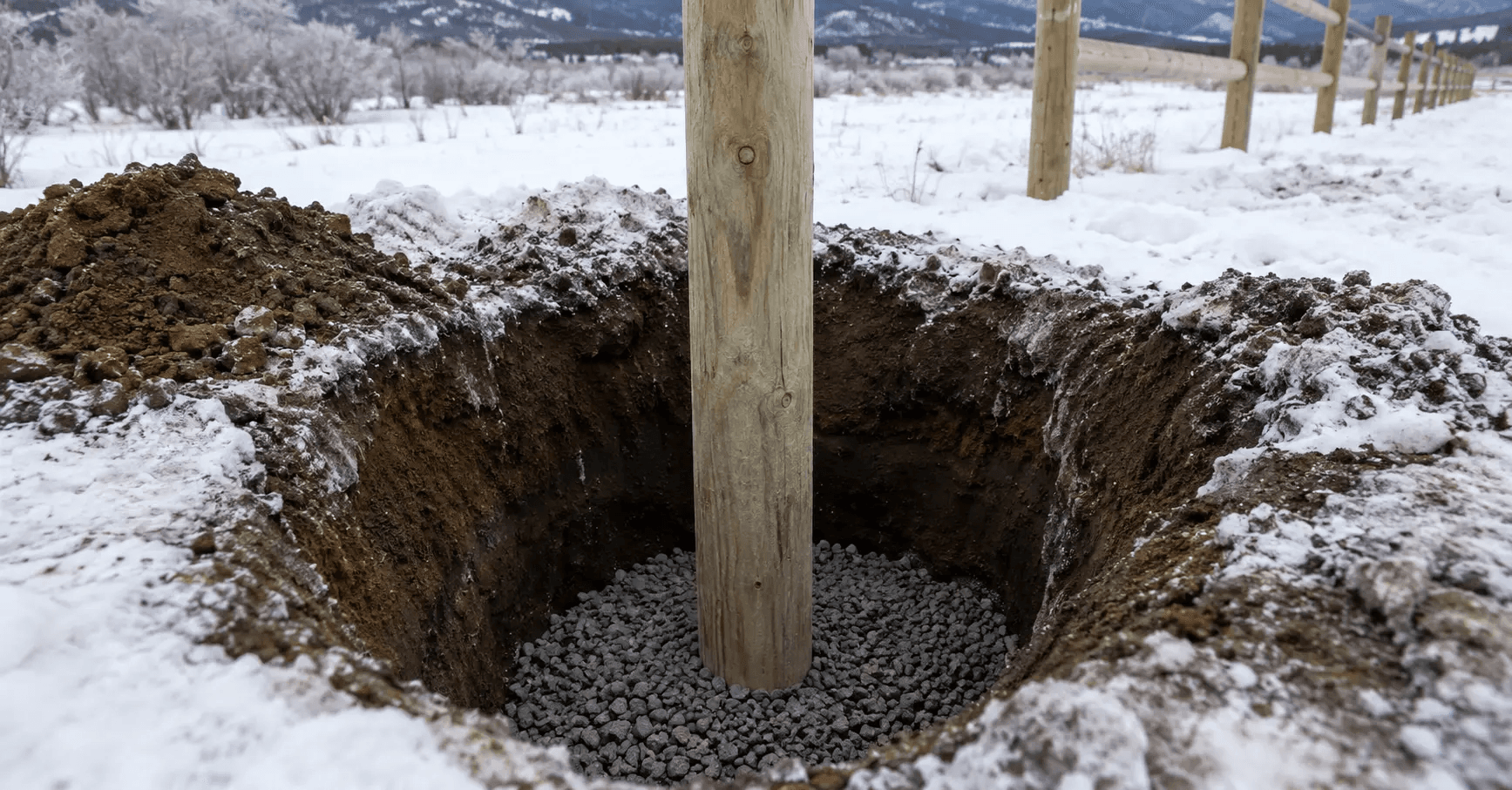
If you're going with concrete, make sure the footing goes all the way below the frost line. Pour it in a bell shape that's wider at the bottom than the top, which makes it harder for the soil to push upward. And always put 3 to 4 inches of gravel at the very bottom of the hole before you set the post. Gravel doesn't hold water, so it gives moisture a place to drain away from the base of the post instead of pooling there and freezing.
Some fence builders in cold climates skip concrete entirely for line posts and just use tamped gravel all the way up. Gravel compacts tightly around the post, drains well, and doesn't conduct cold the way concrete does. It's a legitimate approach, especially for standard wood privacy fences where the posts aren't bearing a lot of lateral force.
How to Set Posts in Cold Climates the Right Way
Dig below the frost line plus 6 inches. If your frost line is 42 inches, dig to 48. Use a post hole digger or a power auger to keep the holes consistent. For cold climate work, a power auger is worth renting because you're digging a lot of deep holes.
Start with gravel. Drop 3 to 4 inches of gravel in the bottom of every hole. This creates a drainage pad that keeps water from sitting under the post and freezing.
Set the post and check plumb. Drop the post in, check it with a level on two sides, and brace it in place. Take your time here. A post that goes in crooked stays crooked.
Fill with concrete or gravel. If you're using concrete, pour it around the post and stop about 3 inches below ground level. Crown the top of the concrete so water runs away from the post, not toward it. If you're using gravel, fill in 6-inch layers and tamp each one down firmly before adding the next.
Cap the top of the hole with dirt. Whether you used concrete or gravel, finish the top few inches with compacted soil. This gives you a clean finished look and helps direct water away from the post.
Let concrete cure before hanging fence. Give it at least 24 to 48 hours before you put any weight or stress on the posts. In colder weather, concrete takes longer to cure, so err on the side of waiting longer.
What About Post Material?
The type of post matters in cold climates too. Pressure-treated wood is the standard for most residential fence projects. It resists rot and holds up well underground, especially when paired with good drainage.
Steel posts are strong but they conduct cold even more than concrete, which can increase frost heave issues. If you're using steel, make sure it's set well below the frost line with gravel at the base.
Vinyl and composite post sleeves over wood or metal cores are popular for finished looks, but the structural depth requirements are the same. The core material needs to go below the frost line regardless of what's wrapped around it.
Plan Your Whole Fence Before You Dig
Before you start punching holes in the ground, make sure you've got the full project planned out. How many posts do you need? How much concrete? How many rails and pickets? Run your dimensions through our fence calculator to get an accurate material list so you're not making extra trips to the supply yard halfway through the job.
If you're building a deck alongside the fence, the same frost line rules apply to your deck footings. Our concrete calculator can help you figure out how much concrete you need for footings, and the deck board calculator will sort out your decking materials.
Getting your posts deep enough might mean more digging and more concrete, but it's a whole lot cheaper than ripping out a heaved fence and starting over next spring. Do it right the first time and it'll stand for years.