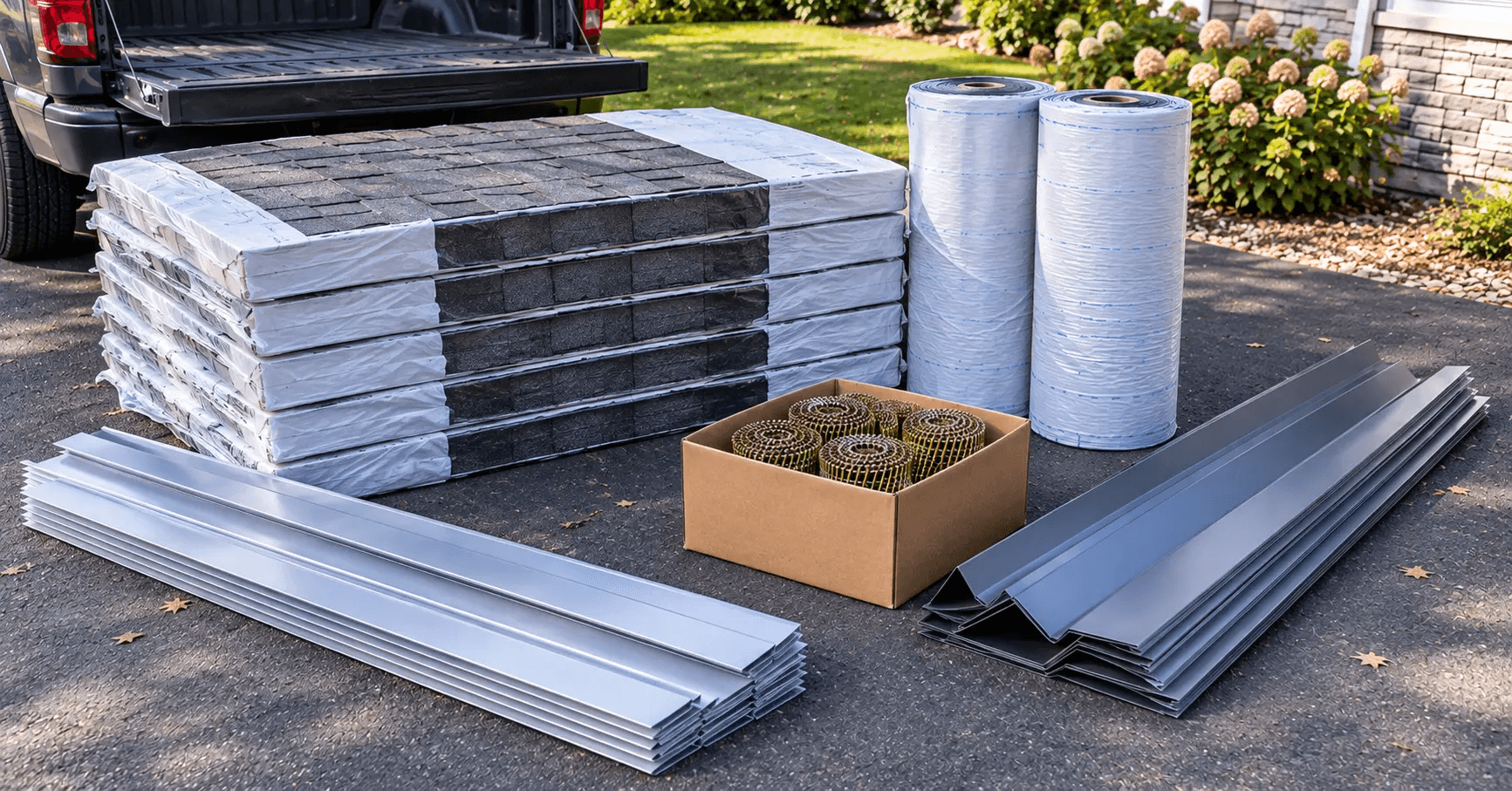
Most roofers get the shingle count close. Where the money leaks is everything else: drip edge, starter, ridge cap, ice and water, underlayment, flashing. Each one is small on its own, and together they are a supply run you didn't price.
Here is the full list and how to count each item.
Get three measurements before anything else
Almost every item below comes from one of three numbers, so get them on the first visit.
Roof area. Footprint times the slope multiplier for the pitch. That gives you squares. The multipliers are in the roof pitch multiplier chart.
Perimeter. Eaves and rakes measured separately. Eaves run level along the bottom edge. Rakes run up the slope at the gable ends, so measure them along the slope, or take the plan length and multiply by the pitch multiplier.
Lines. Ridges, hips, and valleys, each measured separately along the roof surface.
Shingles
Roof area in squares, plus waste: 10 percent on a simple gable, 15 percent on a cut-up roof with hips, valleys, and dormers.
Most architectural shingles run three bundles to the square. Some heavier designer lines run four or five, so check the wrapper before you multiply.
Drip edge
Eaves plus rakes, in linear feet. It's sold in 10 foot pieces and the pieces overlap at the joints, so divide by 10 and add about 10 percent.
Starter strip
Every eave gets starter. Whether the rakes get it depends on the shingle manufacturer, and some require it for the wind warranty. Count eaves, add rakes if the install instructions call for it, and divide by the coverage on the starter bundle. That coverage varies by product.
Ridge and hip cap
Total ridge length plus total hip length. Divide by the linear feet per bundle printed on the cap you're using. This is the item most often found short at the end of the day, because nobody counts hips until they're standing on one.
Ice and water shield
In cold climates, code typically requires an ice barrier running from the eave up to at least 24 inches inside the exterior wall of the house. On a normal overhang that usually takes two courses of a 3 foot roll along every eave. Deep overhangs or low pitches can need a third. Confirm the requirement with your town.
Add a full-length strip down every valley, around chimneys and skylights, and along any low-slope section.
Square footage divided by roll coverage gives you the roll count. Coverage varies by brand, so go by the roll.
Underlayment
Everything the ice and water shield doesn't cover gets underlayment. Roof area minus the ice and water area, plus about 10 percent for laps. Synthetic rolls cover far more than the old felt rolls, so check the coverage on what you're buying.
Flashing
Valleys. If you're running open metal valleys, total valley length plus laps. Valleys run diagonally, so measured off a plan they're longer than they look.
Step flashing. One piece per shingle course wherever the roof dies into a sidewall. Measure the wall run along the slope in inches and divide by the shingle exposure.
Pipe boots, vents, and chimney flashing. Count them on the walkaround. A tear-off is the right time to replace every boot, and it belongs in the quote whether or not the homeowner asked.
Worked example
A simple gable house, 30 by 60 foot footprint including overhangs, 6/12 pitch.
| Item | Measurement | Order |
|---|---|---|
| Roof area | 1,800 sq ft × 1.118 = 2,012 sq ft | 20.1 squares |
| Shingles | 20.1 squares + 10% waste | 23 squares, 69 bundles |
| Drip edge | 120 ft eaves + 67 ft rakes | 21 pieces |
| Starter | 120 ft eaves, 187 ft with rakes | Per bundle coverage |
| Ridge cap | 60 ft ridge | Per bundle coverage |
| Ice and water | Two 3 ft courses × 120 ft | 720 sq ft |
| Underlayment | (2,012 − 720) + 10% | About 1,420 sq ft |
The rakes are 67 feet, not 60, because each one runs 15 feet in plan and climbs at 6/12. Measure rakes off the ground and you'll come up short on drip edge.
Nails
Four nails per shingle is the standard pattern. High-wind areas and some warranties call for six. Count shingles per square off the bundle, multiply, and order with a margin, because running out of coil nails mid-roof costs more than the box.
What goes in the quote, not the takeoff
Some things you can't count until the old roof is off. Extra layers, rotted decking, a skylight that leaked into the framing. Put a price on each of those in the exclusions so you aren't negotiating on the roof. Writing a quote that wins the job covers how.
The short version
- Measure area, perimeter, and lines first. Everything else comes from them
- Shingles are area times pitch multiplier, plus 10 to 15 percent waste
- Drip edge is eaves plus rakes, in 10 foot pieces, plus 10 percent
- Starter goes on every eave, and on the rakes if the manufacturer requires it
- Ridge cap covers ridges and hips together
- Ice and water runs from the eave to at least 24 inches inside the wall, plus valleys and penetrations
- Underlayment covers everything else, plus laps
- Measure rakes and valleys along the slope, not off the plan
- Check bundle and roll coverage on the actual product, because it varies
The roofing calculator runs the main counts from your measurements. If you need to convert pitch first, roof pitch to degrees has the chart.