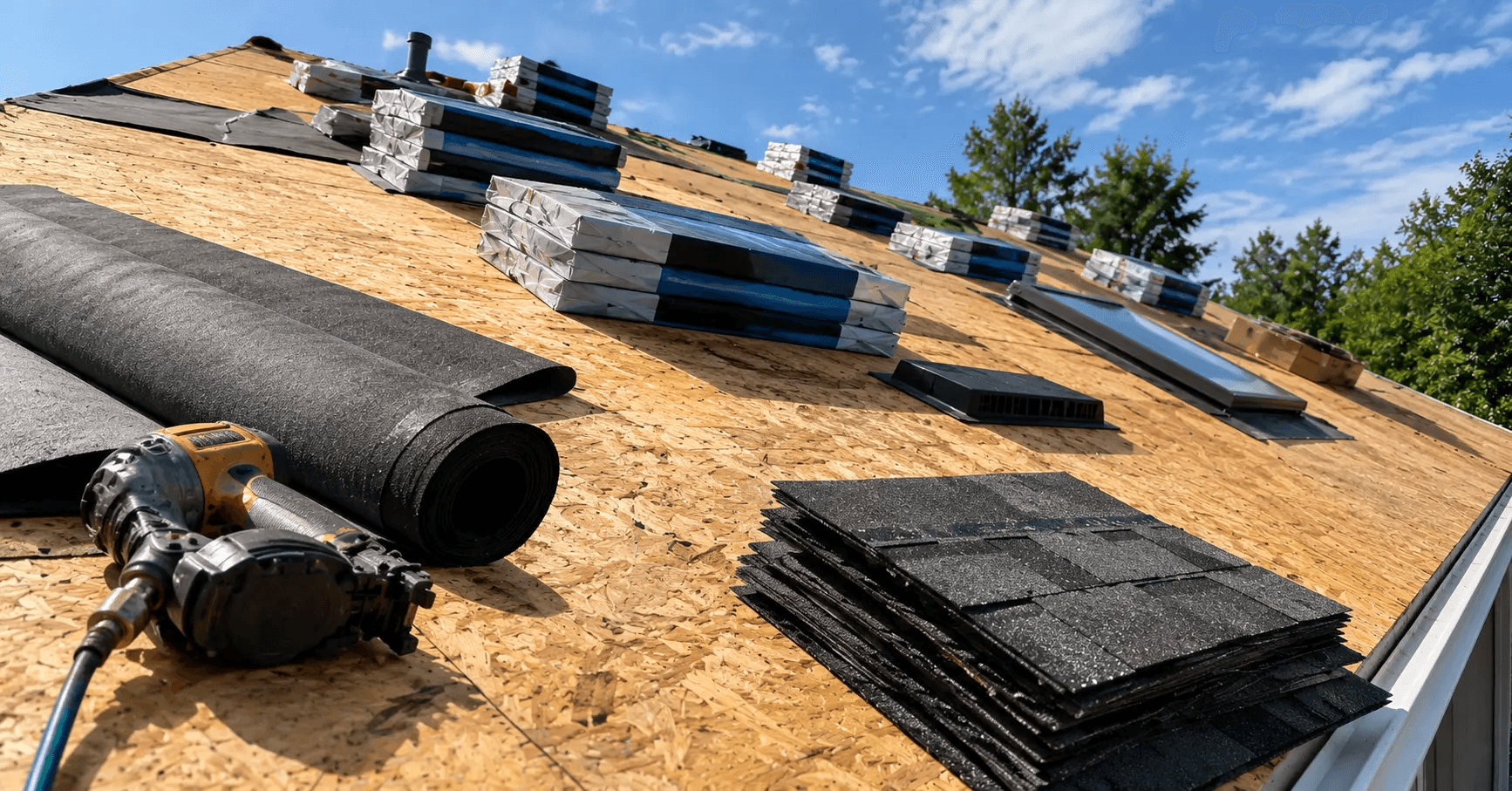
The number that matters when you are ordering shingles is not the square footage of the house. It is the square footage of the roof, and on anything steeper than flat those two are different numbers.
The pitch multiplier is how you get from one to the other. Measure the footprint, multiply, done. It takes thirty seconds and it is the difference between ordering enough material and making a Saturday trip to the supply house.
What the multiplier actually is
A roof is the hypotenuse of a triangle. The footprint is the base.
For every 12 inches you travel horizontally, a 6/12 roof climbs 6 inches. The actual surface you walk on is the diagonal, which is longer than 12 inches. How much longer is the multiplier.
The math is the Pythagorean theorem. Square the rise, add 144, take the square root, divide by 12.
A 6/12 roof works out to the square root of 36 plus 144, which is 180. The square root of 180 is 13.416. Divide by 12 and you get 1.118. That roof has 11.8 percent more surface than the ground it covers.
The chart
| Pitch | Slope multiplier | Hip and valley multiplier |
|---|---|---|
| 1/12 | 1.003 | 1.417 |
| 2/12 | 1.014 | 1.424 |
| 3/12 | 1.031 | 1.436 |
| 4/12 | 1.054 | 1.453 |
| 5/12 | 1.083 | 1.474 |
| 6/12 | 1.118 | 1.500 |
| 7/12 | 1.158 | 1.530 |
| 8/12 | 1.202 | 1.563 |
| 9/12 | 1.250 | 1.601 |
| 10/12 | 1.302 | 1.641 |
| 11/12 | 1.357 | 1.685 |
| 12/12 | 1.414 | 1.732 |
| 14/12 | 1.537 | 1.833 |
| 16/12 | 1.667 | 1.944 |
| 18/12 | 1.803 | 2.062 |
The second column is the one you use for area. The third is for figuring the length of a hip or valley rafter, which runs diagonally across the roof plane and climbs at the same time, so it is longer again.
How to use it
Measure the building footprint, including the overhangs. Length times width gives you the flat area under the roof.
Multiply that by the slope multiplier for your pitch. That is your actual roof area.
Divide by 100 for squares, because that is how roofing is sold.
Here is 1,800 square feet of footprint at four common pitches:
| Pitch | Roof area | Squares | Squares with 10% waste |
|---|---|---|---|
| 4/12 | 1,897 sq ft | 19.0 | 20.9 |
| 6/12 | 2,012 sq ft | 20.1 | 22.1 |
| 8/12 | 2,163 sq ft | 21.6 | 23.8 |
| 12/12 | 2,546 sq ft | 25.5 | 28.0 |
Same house, same footprint. The 12/12 needs about six and a half more squares than the 4/12. Bid the steep roof off the footprint and you are short by a third of a pallet before you have accounted for waste.
Waste
The multiplier gives you the surface. It does not give you the material, because you throw some away.
A simple gable with two rectangles wastes very little. Ten percent is the usual starting point. A cut up roof with hips, valleys, dormers, and skylights wastes a lot more, and fifteen percent is closer on anything complicated. Valleys in particular eat material, because every course dies into the valley at an angle and the offcut goes in the trailer.
Add starter, ridge cap, and hip cap separately. Those are linear foot items, not square items, and folding them into a waste percentage is how you end up short on cap at four in the afternoon.
Measuring the pitch itself
If you do not already know the pitch, you need it before any of this works.
From inside the attic, hold a level against a rafter, mark 12 inches along it, and measure straight down from that mark to the rafter. That measurement is your rise.
From outside, same idea against a rake board or on the roof itself if it is safe to be up there.
From the ground, you can estimate it off a photo taken square to the gable end, which is good enough for a quote but not for an order. If you want the conversions between pitch, degrees, and slope, that is in roof pitch to degrees.
Where the multiplier does not help
It gives you area. It does not give you anything else, and the things it leaves out are the things that get forgotten.
Ridge, hip, and valley lengths are linear measurements. Use the hip and valley multiplier for those, run by run.
Flashing, step flashing at walls, pipe boots, and drip edge are all counted separately off the actual roof, not derived from the area.
Ice and water shield in cold climates goes where code says it goes, usually a set distance up from the eave measured along the slope, plus valleys. That is its own takeoff.
Tear off and disposal scales with the area and with how many layers are up there, which you do not know for certain until you open it.
That last one belongs in the exclusions on your quote with a price attached, same as any other thing you cannot see from the driveway. Writing a quote that wins the job covers how to structure that.
The short version
- Footprint area times the slope multiplier equals actual roof area
- Multiplier is the square root of rise squared plus 144, divided by 12
- 6/12 is 1.118, meaning 11.8 percent more roof than footprint
- 12/12 is 1.414, which is over 40 percent more
- Divide by 100 for squares
- Add 10 percent waste on a simple roof, 15 on a cut up one
- Use the hip and valley multiplier for diagonal rafter lengths
- Count starter, ridge, cap, and flashing separately as linear items
- Measure the pitch before you order anything
Run your numbers through the roof pitch calculator if you want the multiplier and the area done for you, and keep the chart above on your phone for when you are standing in somebody's yard without signal.