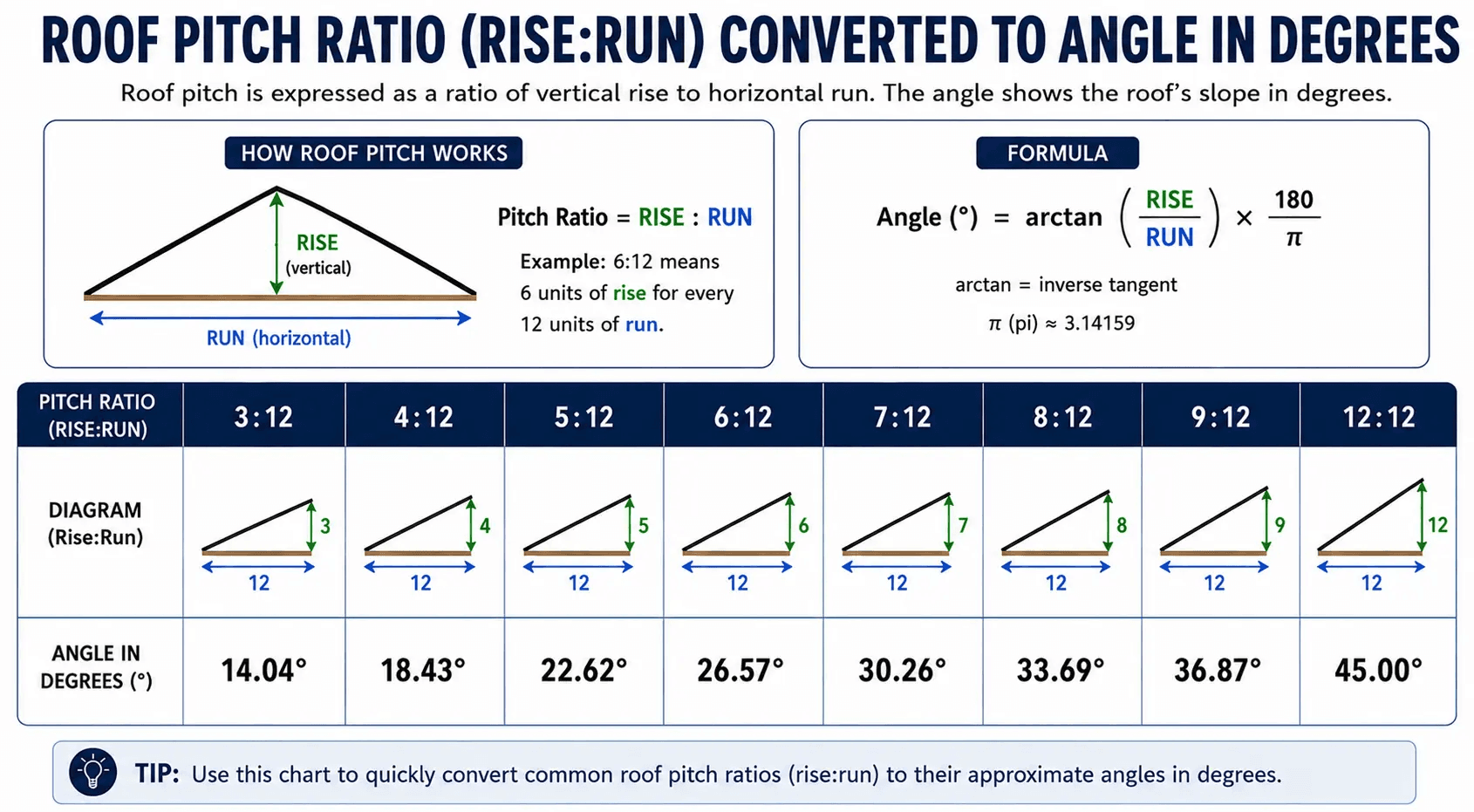
Roof pitch and roof angle are two ways of saying the same thing, but they use completely different numbers. Pitch is written as a ratio like 6:12. Angle is written in degrees like 26.57. If you've got one and need the other, you need to convert, and that trips up a lot of people because the two don't line up in any obvious way.
Maybe you've got a pitch from a set of plans and need the angle to set your saw. Maybe an architect spec'd the roof in degrees and you think in rise-over-run. Either way, this guide has the conversion chart you need plus the simple math behind it.
If you just need the answer fast, drop your numbers into our roof pitch calculator and it'll convert between pitch, degrees, and slope instantly. If you want to understand how it works, keep reading.
Pitch and Degrees Are Not the Same Thing
Let's clear up the basic confusion first. Roof pitch is expressed as rise over run, almost always with a run of 12. So a 6:12 pitch means the roof rises 6 inches for every 12 inches it travels horizontally. The "12" is the standard base that roofers use.
The angle in degrees is the actual angle the roof makes with the horizontal, measured the way you'd measure any angle with a protractor. A 6:12 pitch and a 26.57 degree angle describe the exact same slope. They're just two different languages for the same thing.
The reason they don't line up neatly is that pitch is a ratio and degrees come from trigonometry. Doubling the pitch doesn't double the angle. That's why you need a chart or a calculation rather than just a simple multiplier.
Roof Pitch to Degrees Conversion Chart
Here's the reference chart for the most common roof pitches and their angle equivalents. These are rounded to two decimal places.
1:12 = 4.76 degrees
2:12 = 9.46 degrees
3:12 = 14.04 degrees
4:12 = 18.43 degrees
5:12 = 22.62 degrees
6:12 = 26.57 degrees
7:12 = 30.26 degrees
8:12 = 33.69 degrees
9:12 = 36.87 degrees
10:12 = 39.81 degrees
11:12 = 42.51 degrees
12:12 = 45 degrees
13:12 = 47.29 degrees
14:12 = 49.4 degrees
15:12 = 51.34 degrees
16:12 = 53.13 degrees
18:12 = 56.31 degrees
24:12 = 63.43 degrees
Notice that a 12:12 pitch is exactly 45 degrees. That's the one easy reference point, because at 12:12 the rise equals the run, which makes a perfect 45 degree angle. Everything else takes a calculation.
How to Convert Pitch to Degrees Yourself
The math is simpler than it looks if you've got a calculator with a tangent function. The formula is:
Angle in degrees = arctangent (rise divided by run)
So for a 6:12 pitch, you take 6 divided by 12, which is 0.5. Then you find the arctangent (sometimes labeled tan⁻¹ on a calculator) of 0.5, which gives you 26.57 degrees.
For a 9:12 pitch, it's 9 divided by 12, which is 0.75. The arctangent of 0.75 is 36.87 degrees.
That's the whole thing. Rise divided by run, then arctangent. The only catch is you need a scientific calculator or a phone calculator in scientific mode to find the arctangent. Or you skip all of it and use our roof pitch calculator, which does the conversion the second you type in your numbers.
How to Convert Degrees Back to Pitch
Going the other direction works the same way in reverse. If you have the angle in degrees and need the pitch, the formula is:
Rise = tangent (angle) times 12
So if you have a 30 degree roof, you take the tangent of 30, which is about 0.577, and multiply by 12 to get a rise of roughly 6.93. That means a 30 degree roof is about a 6.93:12 pitch, which rounds to right around 7:12.
This comes up a lot when plans or specs are given in degrees but you need to order materials or set up your framing in standard pitch terms. A few common degree-to-pitch conversions:
20 degrees = about 4.37:12 pitch
25 degrees = about 5.6:12 pitch
30 degrees = about 6.93:12 pitch
35 degrees = about 8.4:12 pitch
40 degrees = about 10.07:12 pitch
45 degrees = exactly 12:12 pitch
Why You Might Need the Conversion
There are a bunch of real-world reasons this conversion matters on the job.
Setting saw angles. When you're cutting rafters or framing, your saw works in degrees but your roof is spec'd in pitch. You need the degree equivalent to set the bevel correctly.
Reading plans. Architects and engineers often note roof slopes in degrees, while most roofers and framers think in pitch. Converting lets everyone work from the same understanding.
Material requirements. Some roofing materials have minimum slope requirements stated in degrees, others in pitch. Knowing both lets you confirm a material will work for a given roof.
Solar and equipment installs. Solar panel calculations, satellite dishes, and other roof-mounted equipment often reference angle in degrees. If you only know the pitch, you'll need to convert.
Don't Have Your Measurements Yet?
This whole guide assumes you already know the pitch or angle of the roof you're working with. If you don't have that number yet and need to figure it out, check out our guide on how to measure roof pitch from the ground. It walks through four ways to get an accurate pitch reading without even climbing a ladder, which is handy when you're putting together a quote from the driveway.
Once you've got your rise and run, you can come back here for the conversion or just run the whole thing through the calculator.
Get the Exact Number Instantly
Conversion charts are great for the common pitches, but if you're working with an odd pitch or need precision down to the decimal, the math by hand gets tedious. Our roof pitch calculator handles any pitch or angle you throw at it and converts between pitch, degrees, slope percentage, and rafter length in one shot.
It's free, it works on your phone, and it beats punching arctangents into a calculator on the tailgate of your truck. Bookmark it and you'll have the conversion ready whenever a job calls for it.