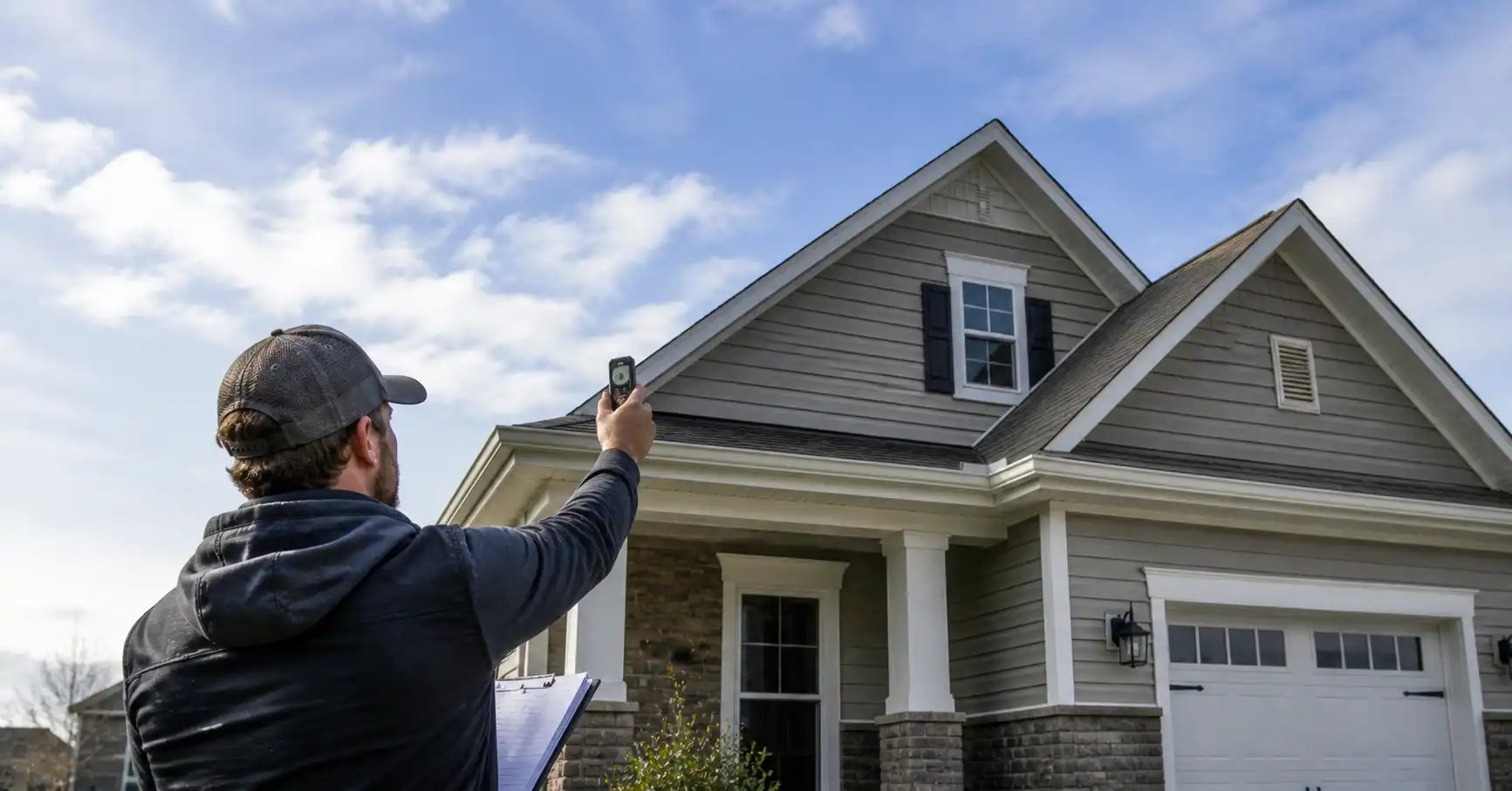
Sometimes you need to know a roof's pitch before you ever set foot on it. Maybe you're putting together a quote from the driveway. Maybe a homeowner called and wants a ballpark number before you come out. Or maybe the roof is steep enough that you'd rather get an estimate from the ground before hauling out the harness and safety gear.
Whatever the reason, you don't always need a ladder, a level, and attic access to figure out a roof's pitch. There are a few ways to get a solid estimate without leaving the ground, and they're accurate enough for most quoting and planning purposes.
What Roof Pitch Actually Means
Before we get into the methods, let's make sure we're on the same page about what pitch means. Roof pitch is the measurement of how steep a roof is. It's expressed as a ratio of how many inches the roof rises vertically for every 12 inches it runs horizontally. So a 6:12 pitch means the roof goes up 6 inches for every 12 inches of horizontal distance.
Most residential roofs fall somewhere between 4:12 and 9:12. Anything below 4:12 is considered low slope, and anything above 9:12 starts getting steep enough that walking on it requires extra precaution. Knowing the pitch matters because it affects the type of roofing material you can use, how much material you'll need, how you install it, and how much you should charge for the job.
Once you've got your measurements, you can plug them into our roof pitch calculator to get the exact pitch, angle in degrees, and rafter length without doing the math by hand.
Method 1: Measure the Gable End
This is the most reliable way to measure pitch from the ground, and it works on any house with a visible gable end. That's the triangular wall section where you can see the roof line going up to the peak.
Here's what you do. Stand back far enough to see the full gable end clearly. You'll need a tape measure long enough to reach, or a laser measure if you've got one.
First, measure the total width of the gable wall from one side to the other. That's your span. Divide that number by 2 to get your run. So if the gable wall is 30 feet wide, your run is 15 feet.
Next, measure from the base of the gable (where the roof line meets the top of the wall) straight up to the peak. That's your total rise.
Now divide the rise by the run, then multiply by 12. That gives you the pitch in the standard inches-per-foot format. For example, if the rise is 7.5 feet and the run is 15 feet, that's 7.5 divided by 15, which equals 0.5. Multiply by 12 and you get a 6:12 pitch.
Or just take your rise and run measurements and drop them into the roof pitch calculator. It'll do all the math for you and convert it to degrees too.
Method 2: Use a Pitch Gauge
A pitch gauge, sometimes called a roof protractor, is a cheap tool you can pick up at most hardware stores for under $20. You hold it up from the ground, line it up with the roof's edge, and read the pitch directly off the scale.
Stand far enough back that you can clearly see the slope of the roof. Hold the gauge at arm's length and align the base with the horizontal and the angled edge with the roof line. The reading on the gauge gives you the pitch.
It's not as precise as measuring with a level and tape on the roof itself, but it's accurate enough for estimating purposes. If you're a roofer or general contractor, keeping one of these in your truck is worth the small investment. It'll save you time on every initial site visit.
Method 3: Use a Smartphone App
There are several apps available for both iPhone and Android that use your phone's built-in sensors to measure angles. Some are specifically designed for roof pitch, while others are general inclinometer or level apps that work just as well.
The way most of these work is you point your phone at the roof's edge from the ground and the app calculates the angle. Some apps let you take a photo and measure the angle from the image, which can be handy if you want to save the measurement for later.
A few worth trying include Roof Pitch Factor for iPhone and various pitch finder apps on Android. The accuracy can vary depending on how steady your hand is and how far away you're standing, but for a quick estimate from the driveway, they get the job done.
Just keep in mind that the angle these apps give you is in degrees, not in the rise-over-run format most contractors use. You can convert it using our roof pitch calculator, which handles degree-to-pitch conversions.
Method 4: Use Aerial Imagery
This one might sound high-tech, but it's simpler than you think. Google Maps satellite view gives you a top-down look at the roof. You can't measure pitch directly from a satellite image alone, but combined with some basic measurements from the ground or from a listing, you can get a usable estimate.
Some roofing measurement services and apps use aerial imagery to calculate roof dimensions, pitch, and even generate material lists without anyone setting foot on the property. If you're doing a lot of quoting and want to speed up the process, these tools can pay for themselves pretty quickly.
For most guys doing a handful of estimates a week, the gable end method or a pitch gauge is all you need. But if you're scaling up and trying to knock out quotes faster, aerial tools are worth looking into.
How Accurate Are Ground Measurements?
Let's be honest about this. Measuring from the ground is never going to be as precise as putting a level directly on the roof or a rafter in the attic. But for estimating purposes, you can usually get within half a pitch increment, which is close enough for an initial quote.
The gable end method is the most accurate of the bunch because you're working with actual measurements rather than eyeballing angles. Pitch gauges and apps are convenient but can be off by a pitch or two depending on your angle and distance.
For a final bid, you'll want to verify with an on-roof or attic measurement. But for that first call with a homeowner, a ground estimate keeps you from climbing a ladder just to say "yeah, that's about a 7:12."
Common Roof Pitches and What They Mean for the Job
Knowing the pitch isn't just about the number. It affects how you plan the job, what materials you use, and how you price it.
Low pitch (2:12 to 4:12). These roofs need special underlayment and materials designed for low slopes. Standard shingles can work down to about 2:12, but you'll need extra waterproofing underneath. These roofs are easier to walk on but more prone to leaks if not done right.
Conventional pitch (4:12 to 9:12). This is the sweet spot for most residential roofing. Standard asphalt shingles work great, the roof is walkable for most people, and water drains well. The most common pitch in American homes is around 4:12 to 6:12.
Steep pitch (9:12 and above). These roofs shed snow and water fast, but they're harder and more dangerous to work on. Labor costs go up because the job takes longer and requires more safety equipment. Material costs go up too because the steeper the pitch, the more surface area you're covering for the same footprint.
Understanding how pitch affects the scope and cost of a job helps you give homeowners better estimates right from that first conversation.
Get the Numbers Without the Math
Once you've got your measurements from the ground, head over to our roof pitch calculator. Plug in your rise and run, and it'll give you the pitch ratio, the angle in degrees, and the rafter length. No pencil, no scratch paper, no trying to remember trig from high school.
It's a free tool built for contractors who'd rather spend their time on the job than doing math on the tailgate of their truck.