Most fence jobs that lose money lose it on the takeoff, not on the install. You counted posts off the plan, forgot that corners and gates need their own, guessed at pickets, and made three trips to the yard you did not price.
The math is not hard. It is just five separate counts and people do it in their head instead of on paper.
Here is each one.
Start with linear feet, not the lot line
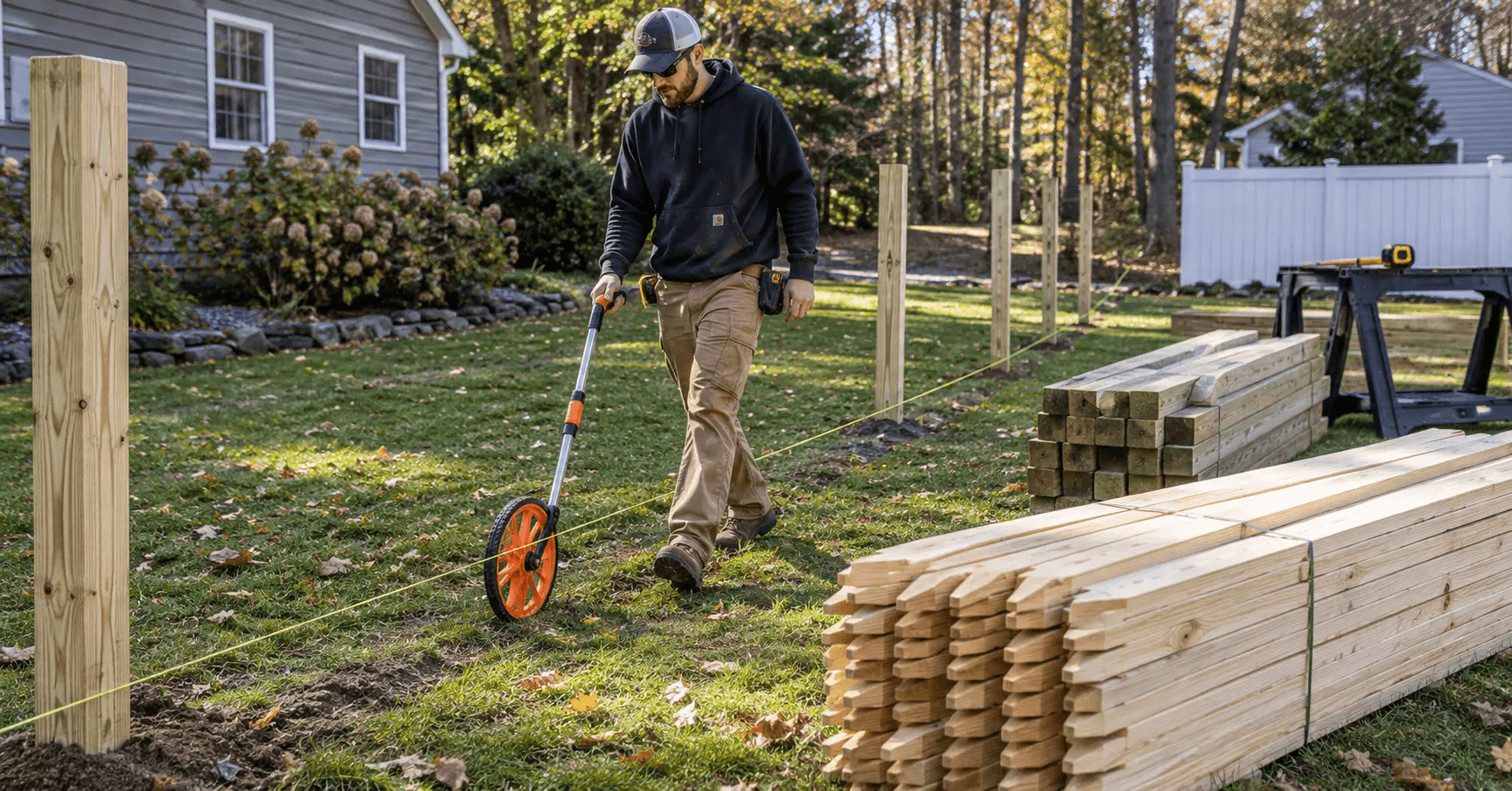
Walk it with a wheel or a long tape and measure the actual fence line, not the property boundary. Those are rarely the same thing once you account for the setback, the corner you are cutting around a tree, or the neighbor's shed.
Measure each straight run separately and write them down as separate numbers. A hundred feet of fence in one straight shot and a hundred feet broken into four runs need different post counts, and if you only carry the total you will be short.
Subtract gate openings from the fenced footage. Gates get their own material.
Posts: it is bays plus one, per run
Divide the run length by your post spacing and round up. That gives you bays. Posts equal bays plus one.
For a 100 foot run:
| Post spacing | Bays | Posts |
|---|---|---|
| 6 ft | 17 | 18 |
| 7 ft | 15 | 16 |
| 8 ft | 13 | 14 |
The plus one is where people come up short, and it compounds. Every separate run gets its own plus one. Four runs means four extra posts over what the straight division gives you.
Then add posts you did not count in the runs. Every corner is a post. Every gate needs a post on each side, and the hinge side should be beefier than a line post, often a 6x6 where the rest are 4x4. An end that terminates at nothing gets a post.
On spacing, 8 feet is the common default because rails come in 8 foot lengths. Go tighter on a tall privacy fence in an exposed spot, because a 6 foot solid fence is a sail and the wind load lands on the posts.
Rails
Count rails per bay, then multiply. Two rails is standard on a 4 foot fence, three on a 6 foot privacy fence, sometimes four on anything taller.
That 100 foot run at 8 foot spacing with three rails is 39 rails. At 6 foot spacing it is 51. Tighter post spacing costs you in rails as well as posts, which is worth knowing before you promise it.
Rails run in the same 8 foot lengths as your bays, so if your spacing is not an even divisor you are cutting and wasting. That is the real reason 8 foot spacing is the default.
Pickets: this is where the gap decides everything
The formula is the run length in inches divided by one picket width plus one gap.
Nominal 1x6 pickets measure about 5.5 inches actual. Here is 100 feet, which is 1,200 inches:
| Gap between pickets | Pickets per 100 ft |
|---|---|
| Butted tight | 219 |
| 1/4 inch | 209 |
| 1/2 inch | 200 |
| 1 inch | 185 |
| 1.5 inch | 172 |
| 2 inch | 160 |
A half inch of gap across a hundred feet is nineteen pickets. On a four hundred foot job that is most of a bundle, and it is the single easiest thing to get wrong because the gap is usually decided on site after the material is already ordered.
Settle the gap with the customer before you do the takeoff, not after.
One more thing on gaps. Pressure treated pickets usually ship wet and will shrink, so a fence butted tight at install opens up on its own. If the customer wants true privacy with no daylight through it, that is a board on board or shadowbox fence, not a tight butted one. Promise privacy on a butted fence and you will be back in a year.
Board on board and dog ear
Board on board runs an underlayer with gaps and then an overlayer covering those gaps. Budget roughly half again as many pickets as a solid butted fence, because you are effectively paying for the overlap. Work it off the actual reveal you plan to leave rather than a rule of thumb if the run is long.
Shadowbox alternates pickets on opposite sides of the rails. Same material story, looks the same from both sides, which matters when the neighbor is going to see the back of it.
Dog ear is just a picket top profile, not a layout. It does not change the count. It does change the look and it is cheaper than a custom cut top, which is worth mentioning when somebody wants a decorative top edge on a budget.
Concrete, if you are setting posts in it
A 10 inch diameter hole at 36 inches deep is about 1.64 cubic feet. A 4x4 post sitting in it displaces about 0.26, so you need roughly 1.38 cubic feet of concrete per hole.
| Bag size | Bags per hole |
|---|---|
| 50 lb | About 3.7 |
| 60 lb | About 3.1 |
| 80 lb | About 2.3 |
Scale that up for a wider or deeper hole, and gate and corner posts usually get both. Deeper matters in cold country, because the bottom of that hole has to sit below the frost line or the post walks up out of the ground over a few winters. That is covered in how deep fence posts need to go in cold climates.
And you do not have to concrete every post. Compacted crushed stone holds line posts fine and drains better, which is the longer answer in concrete versus gravel.
The stuff that never makes it onto the list
Gate hardware. Hinges, latch, drop rod, and a cane bolt on a double gate. Buy hardware rated heavier than you think, because a sagging gate is the number one callback on a fence.
Fasteners. Exterior rated, compatible with treated lumber, and a lot more of them than you would guess. Two per picket per rail on a three rail fence is six per picket.
Post caps, if the design has them.
Waste. Add five to ten percent on pickets for crooks, splits, and bad ends. The yard is not sorting the bundle for you.
Disposal, if there is an old fence coming out. Demo labor and a dumpster or trailer loads, and old posts set in concrete come out slow.
Check it against a price per foot
Once you have the takeoff, divide your total material cost by the linear feet and see where it lands against your usual number. If it is way off, something in the count is wrong or the job is genuinely unusual. Either way you want to know before the quote goes out, not after.
That is the same backwards check worth running on your markup. The takeoff tells you cost, and cost is only half the number you are charging. Markup versus margin covers the other half.
The short version
- Measure the fence line, not the property line, and record each run separately
- Posts equal bays plus one, per run, then add corners, ends, and two per gate
- Rails are bays times rails per bay, usually two or three
- Pickets are run length in inches divided by picket width plus gap
- Settle the gap before you order, it swings the count more than anything else
- Board on board runs roughly half again the pickets of a solid fence
- Figure concrete per hole, and remember gate and corner posts take more
- Add gate hardware, fasteners, caps, and five to ten percent picket waste
- Divide finished material cost by linear feet and sanity check it
Run your numbers through the fence calculator if you want the counts done for you, then use this to catch what the calculator does not know about, which is the gates, the corners, and the old fence sitting in the way.