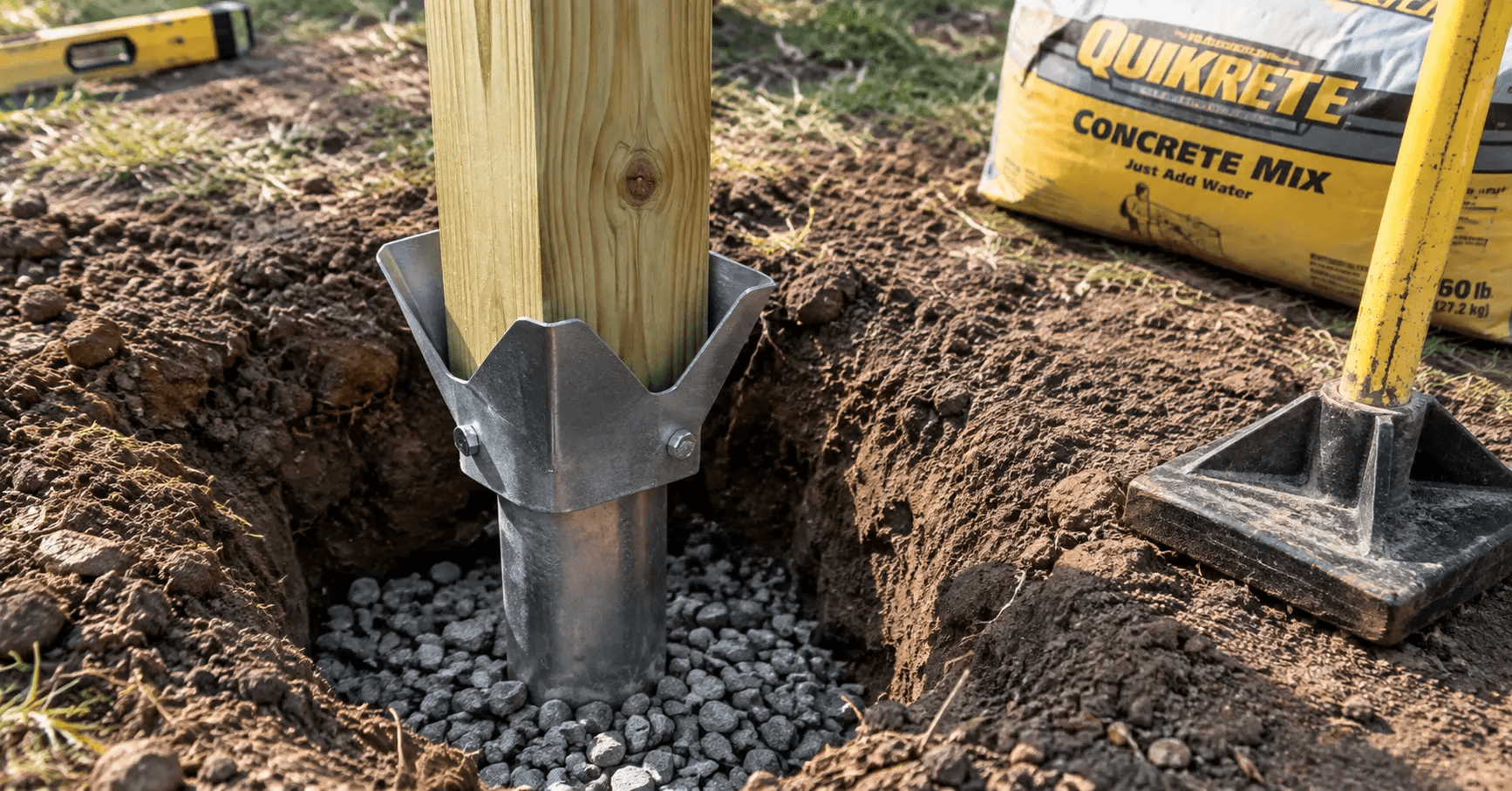
Ask five fence guys what goes in the hole and you will get a real argument. Concrete every post. Gravel every post. Concrete on the corners and gravel on the lines. Everybody is certain, and most of them have fences still standing to prove it.
They are all partly right, because the answer depends on which post it is and what the ground does in winter. Here is how to decide.
What each one is actually for
Concrete gives you rigidity. It turns the post and the surrounding soil into one mass, which is what you want where the post has to resist something pulling on it sideways.
Gravel gives you drainage and movement. Water runs through it instead of sitting against the post, and the post can shift a hair without something cracking.
Those are two different jobs. A gate post and a line post in the middle of a straight run are not doing the same work, so there is no reason they have to get the same treatment.
Where concrete earns its place
Some posts carry real load and need to not move at all.
Gate posts. A gate hangs off one side of a post and swings. That is constant leverage trying to pull the top toward the opening. Gate posts get concrete, and usually a deeper and wider hole than the line posts.
Corner and end posts. On any fence with tension in it, corners and terminals take the pull of the entire run. Concrete.
Tall privacy fence in wind. A six foot solid privacy fence is a sail. Wind load on a solid panel is significant, and on an exposed lot the line posts are working harder than they would behind a tree line.
Loose or sandy soil. If the native soil will not hold a post on its own, gravel will not fix that. Concrete gives you the mass.
Where gravel is the better answer
Wood posts you want to last. This is the strongest argument for gravel and it is about rot. Even treated posts rot, and they rot at the ground line where wet meets air. Gravel lets that zone drain and dry between rains. Concrete, done wrong, does the opposite.
Ground that stays wet. Heavy clay, low spots, anywhere water sits. Gravel gives the water somewhere to go.
Posts you may need to replace. A gravel-set post comes out with a truck and a chain. A concrete-set post comes out with a jackhammer or a new hole next to the old one. On a long fence, some posts will fail eventually, and how replaceable they are matters.
Ordinary line posts on a normal fence. Four foot picket, split rail, anything not fighting wind or tension. Properly compacted gravel holds these fine.
The frost problem, which is the cold climate part
Frost does two things to a fence post and they are different problems.
The first is the one everyone knows. If the bottom of the post sits above the frost line, freezing soil under it pushes it up. That is a depth issue, not a fill issue, and no amount of concrete fixes it. We covered that in how deep fence posts need to go in cold climates, and it is the first thing to get right.
The second is the one that catches people. Frozen soil bonds to whatever it is touching and drags it upward. This is adfreeze, and a smooth concrete collar with four feet of surface area in wet soil is exactly the shape frost likes to grab. You can set a post below the frost line and still watch it walk up out of the ground over a few winters because the sides got gripped.
Two things fight it. Flare the bottom of the concrete wider than the top, so frost pulling on the sides has to lift a wedge that is anchored under undisturbed soil. And keep the water out, because adfreeze needs saturated soil to work. Gravel at the base and clean backfill both help.
This is the same mechanic that lifts deck footings in a New Hampshire winter. Same physics, same fixes.
If you use concrete, do these three things
Most concrete post failures are not concrete's fault. They are installation.
Gravel underneath, always. Four to six inches of compacted gravel at the bottom of the hole before anything else, and set the post on it. Do not encase the bottom end of a wood post in concrete. Water gets in from above no matter what you do, runs down the post, and if the bottom is sealed in a concrete cup it sits there. That is how you rot a post from the bottom up while the top looks perfect.
Crown the top of the collar. The concrete should slope away from the post at the surface, like a small cone, so water runs off. A flat or dished top is a bowl that holds water against the post at exactly the elevation where rot starts. Take the extra thirty seconds per post and shape it.
Keep the collar below grade or seal the joint. Where concrete meets wood there will always be a gap eventually, because they move differently. Either finish the concrete a couple inches below grade and cover it with soil that drains, or crown it and accept that the joint needs looking at.
One more: mix the concrete. Dumping dry mix in the hole and pouring water on top is common and it produces uneven cure with dry pockets. It works well enough often enough that people keep doing it. On gate and corner posts, mix it properly.
If you use gravel, do these three things
Use the right stone. Angular crushed stone, three quarter inch, no fines. Angular pieces lock together. Round pea stone rolls and does not compact into anything structural.
Compact in lifts. Four to six inches at a time, tamped hard, all the way up. This is the step that gets skipped, and a gravel post that was dumped rather than compacted will lean within a year. It is more work than concrete, not less.
Oversize the hole. A gravel-set post needs more diameter than a concrete one to get the same resistance. Give it room for a real column of stone around the post, not an inch.
The mixed approach
What most experienced crews actually do: concrete on gates, corners, and ends, gravel on the line posts. You get rigidity where the load is and drainage everywhere else, and you have not spent a full day mixing concrete for a fence that did not need it.
On a wet lot, gravel everywhere with concrete only on the gates. On a windy exposed lot with a tall privacy fence, concrete on everything and accept the tradeoff.
Worth saying to the homeowner too. "I'm setting your gate and corner posts in concrete and the line posts in compacted stone so they drain and last longer" sounds like someone who thought about it. It is also the kind of detail that separates your quote from the one that just says fence installation. Same principle as writing out the scope instead of sending a number.
The short version
- Depth below the frost line comes first, fill material does not substitute for it
- Concrete for gates, corners, ends, tall privacy in wind, and loose soil
- Gravel for line posts, wet ground, and anywhere you want the post to last or be replaceable
- Gravel base under the post either way, never seal the bottom in concrete
- Crown the top of a concrete collar so it sheds water
- Flare the bottom of the concrete to fight frost pulling on the sides
- Angular crushed stone, compacted in lifts, in an oversized hole
- Mixed approach is usually the right answer
A fence post does not fail at the bottom of the hole. It fails at the ground line, where water sits and freezes. Whatever you put in the hole, build it so water leaves.