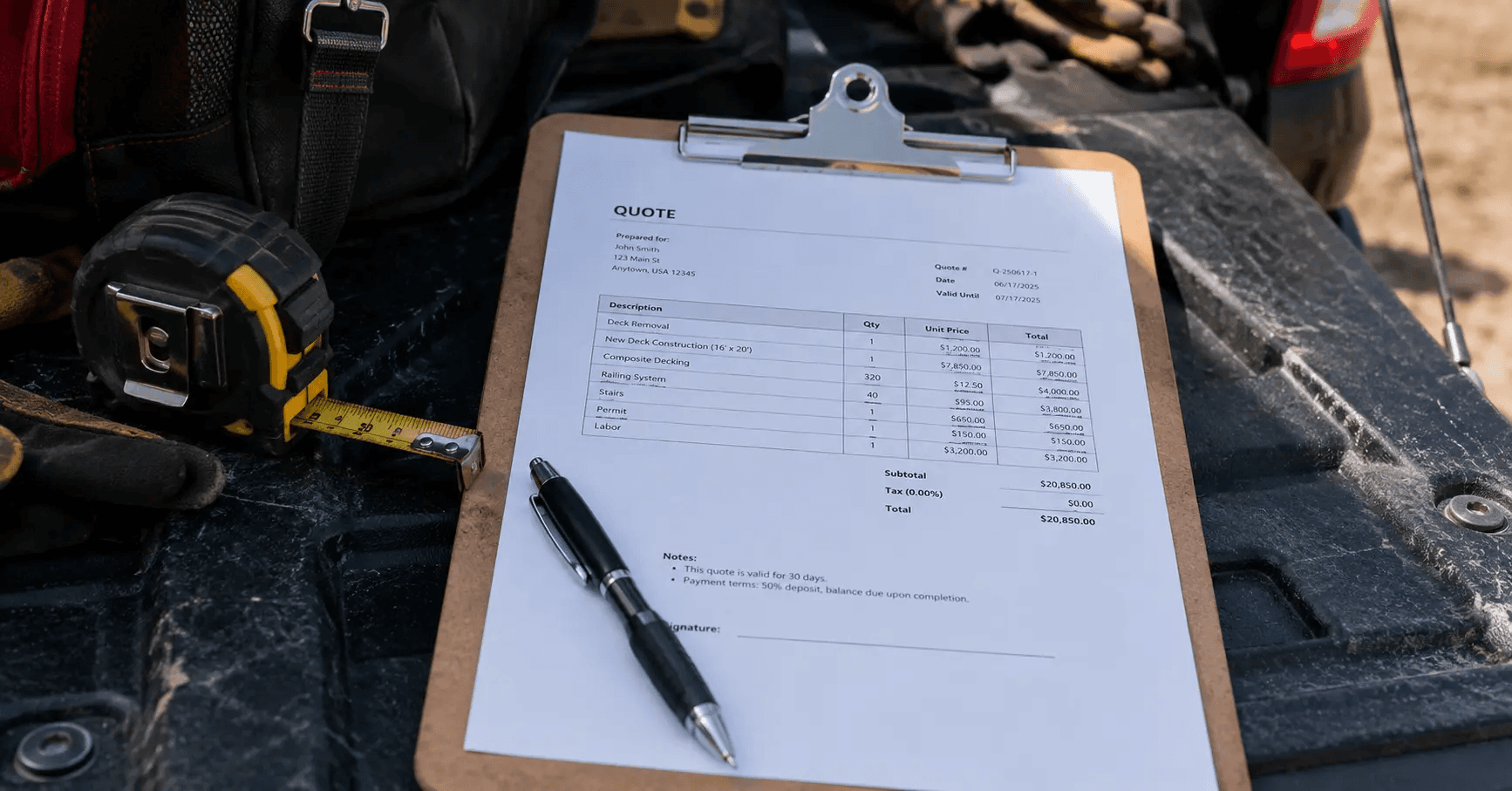
You went out, looked at the job, spent forty minutes with the homeowner, drove back, worked up the numbers, and sent it over. Then nothing. No call, no email, no "we went another direction." Just silence.
Most contractors assume they lost on price. Sometimes that's true. A lot of the time it isn't. The homeowner got three quotes, two of them were confusing scraps of paper with a number on them, and the third one explained exactly what was going to happen. Guess who got the call.
Your quote is the last thing a homeowner sees before deciding. For a lot of them it's the only piece of your work they've held in their hands. Here's how to make it do its job.
Speed matters more than you think
The quote that shows up first gets read the most carefully. By the time the third one lands, the homeowner has already started forming an opinion.
Try to get yours out within 24 hours of the walkthrough. Same day is better. If you're quoting a big job that needs supplier pricing, send a short note that same day saying when the full number will land. That alone puts you ahead of the guy who disappears for a week.
This is the same reason responding to leads faster wins you jobs. Homeowners read speed as competence. Fair or not, if you're slow to quote, they assume you'll be slow on the job.
Send a document, not a number
A text message that says "$8,400 for the roof" is not a quote. It's a price. Prices get compared against other prices, and when all a homeowner has to compare is three numbers, the lowest one wins by default.
A real quote gives them something else to weigh. It shows the thinking behind the number. Two contractors can quote the same roof at $8,400 and $9,100, and the higher one wins regularly, because the higher one explained that it includes ice and water shield six feet up from the eave and the other one didn't mention it at all.
You are not just pricing the work. You are showing the homeowner that you understand their job better than the other guys did.
What actually goes in it
You don't need a fifteen page document. You need these pieces, clearly laid out.
The scope, written in plain English. What you're doing, step by step, in the order it happens. "Tear off existing shingles down to the deck. Replace any rotted sheathing. Install synthetic underlayment and ice and water shield at eaves and valleys. Install architectural shingles. Replace all pipe boots and flashing. Haul away all debris."
That paragraph is doing a lot of work. It tells the homeowner you know the job, and it quietly makes them wonder whether the cheaper quote included the flashing.
What is not included. This is the section most contractors skip and the one that saves you the most grief. Spell out the things people assume are covered. Rotted decking beyond a certain amount. Permits. Painting after the work. Landscaping repair. Anything hidden behind a wall.
Write it as a plain list with the price if extra work comes up. "Sheathing replacement beyond 3 sheets billed at $85 per sheet." Now when you open up the roof and find rot, you are pointing at a line they already read instead of having an argument in the driveway.
Materials, named. Not "shingles." The brand, the line, the color if it's picked. Homeowners look these up. Naming the product makes the whole quote feel more real, and if you're using better material than the other bid, this is the only place they'll ever find out.
A timeline. Roughly when you can start and roughly how long it takes. "Two to three working days, weather permitting. Currently booking about four weeks out." Homeowners are often more anxious about schedule than price, especially on anything involving water, heat, or a room they can't use.
The price and how it gets paid. One clear total. Then the payment schedule, like a deposit at signing, a draw at a milestone, and the balance on completion. Never leave payment terms to be figured out later.
An expiration date. Thirty days is standard. Material prices move and your schedule fills up. It also gives the homeowner a gentle reason to decide instead of sitting on it for two months.
License and insurance info. One line at the bottom. It costs you nothing and it answers a question they were probably too polite to ask.
Itemize carefully
There's a balance here. Not enough detail and the number looks arbitrary. Too much detail and you hand the homeowner a shopping list to pick apart.
If you break out every screw and every hour, you invite the conversation where they ask you to drop the gutter guards, then the disposal fee, then wonder aloud why labor is so much. Now you're negotiating against yourself line by line.
Group things into a handful of chunks instead. Tear off and disposal. Materials. Installation labor. Permit. That's enough for them to see where the money goes without giving them a menu to trim.
Give them options when it fits
When the job allows it, present two or three versions instead of one number. Standard, better, best.
This does something useful. It moves the homeowner from asking "should I do this at all" to asking "which one of these do I want." You've quietly changed the question.
It also protects you from the price shopper. If your one number lands high, you look expensive. If your middle number lands high but there's a lower option sitting right next to it, you look like someone who gave them a choice.
Most people pick the middle. Price the middle one where you actually want to work.
Make it easy to say yes
Think about what you're asking the homeowner to do. If your quote requires them to print it, sign it, scan it, and email it back, you just added a chore between them and hiring you. Plenty of people mean to do it and never get around to it.
Let them approve it from their phone. A quote they can open, read, and sign digitally while sitting in the truck line at their kid's school gets accepted at a much higher rate than a PDF attachment that needs a printer. This is one of the reasons we build digital quotes and e-signatures into contractor sites. The friction between "I want this" and "it's booked" should be as close to zero as you can get it.
Follow up twice, then let it go
Most contractors send the quote and wait. Meanwhile the homeowner got busy, meant to reply, and forgot. Silence is not always a no.
Two follow ups is the right number. Around day three, a short check in asking if they had questions about anything in it. Around day ten, a note that you're holding schedule availability and wanted to see where they landed.
Keep both short and keep the pressure out of them. "Just wanted to make sure this got to you. Happy to walk through any of it if something wasn't clear." That's it. If you'd rather not think about it every time, this is exactly the kind of thing worth setting up to run automatically.
After the second one, move on. Chasing a third and fourth time makes you look like you need the work.
When they say the price is too high
Do not immediately cut the number. If you drop a thousand dollars the moment someone pushes back, you've told them the first price was made up.
Ask what they're comparing it to. Half the time the other quote is missing something, and once you know what, you can point at the difference without trashing the other contractor. "That sounds about right for a straight overlay. Ours is a full tear off, which is why there's a gap."
If you do move on price, take something out. Reduce the scope, change a material, drop a stage. The price came down because the work came down. That keeps your pricing honest and keeps you from training people to haggle.
And some jobs you should let go. If someone is grinding you on price before you've even started, they'll grind you on change orders too. The contractors who end up with better jobs are usually the ones who got comfortable walking away from the bad ones.
Use the same template every time
Build one document you can fill in and reuse. Same layout, same sections, same exclusions list, same terms. Your logo at the top and your license number at the bottom.
This does three things. It makes quotes faster to produce, which means you send them sooner. It makes you look established, because a consistent branded document reads as a real company. And it means you stop forgetting the exclusions section on the one job where it turns out you really needed it.
The short version
- Send it within 24 hours
- Write the scope out in plain steps, not one line
- List what is not included, with prices for the likely extras
- Name the actual materials
- Give a timeline and a payment schedule
- Put an expiration date on it
- Group costs into a few chunks, not a line item menu
- Offer two or three options when the job allows
- Let them sign it from their phone
- Follow up twice, then move on
A good quote will not win you a job you had no shot at. What it will do is win you the ones where you were close, and that's most of them. If a quarter of the jobs you lose are coin flips, tightening this up is worth more than any amount of new leads.