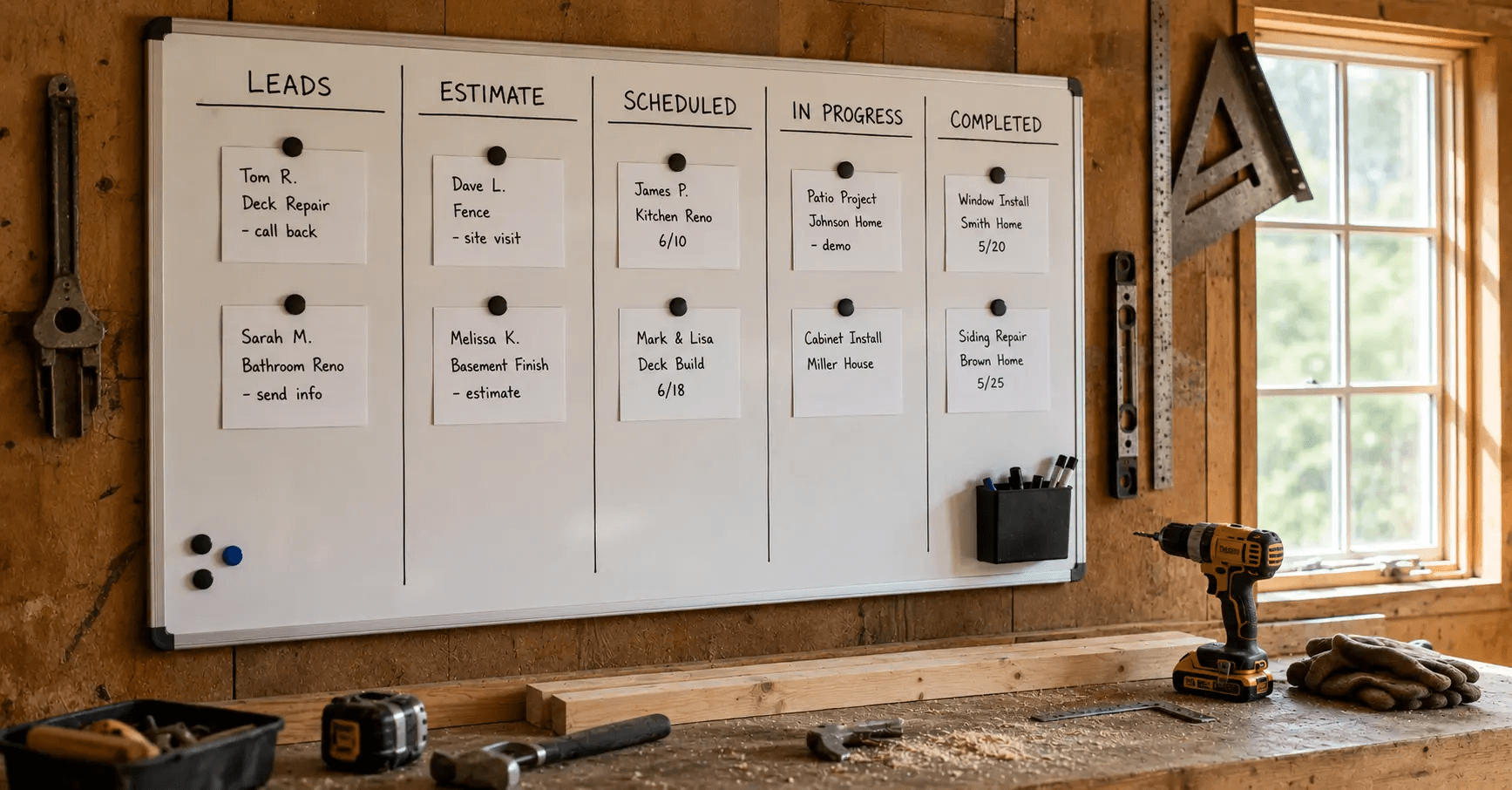
Here's the situation most contractors know too well. A lead comes in while you're on a roof. Another one hits your voicemail during a walkthrough. A third fills out your website form Saturday morning while you're at your kid's game. By Monday you've got four inquiries scattered across your phone, your email, and a sticky note on the dash, and you're honestly not sure which ones you've called back.
Some of them go cold. Not because you didn't care, but because you were working. That's the reality of running a trade business where the person selling the job is the same person swinging the hammer.
Automation is how you stop losing those. Not the creepy kind that makes you sound like a call center, but simple systems that make sure nothing sits unanswered while you're on a job. Here's how to set it up.
What "Automating Leads" Actually Means
Let's clear up the term first, because it sounds more complicated than it is. Automating your leads doesn't mean a robot does your sales for you. It means the boring, repeatable parts happen without you thinking about them.
Specifically: every lead lands in one place automatically. You get told the second one arrives. The first acknowledgment goes out without you having to type it. And you get reminded about anyone who hasn't heard back. That's it. You still do the actual selling. The system just makes sure nobody falls through the cracks while you're busy.
Step 1: Funnel Every Lead Into One Place
This is the foundation and nothing else works without it. Right now your leads probably arrive through your website form, your cell phone, text messages, email, your Google Business Profile, and Facebook. Six channels, six places to check, and no single view of who's waiting on you.
That scattering is why leads get missed. It's not carelessness. It's that no human reliably checks six inboxes while running a crew.
The fix is getting everything into one list you can scan in ten seconds. Website form submissions should flow automatically into wherever you track leads, not just into an email inbox you check twice a week. Once every lead lands in the same place, you can actually see your pipeline instead of hoping you remembered everyone.
Step 2: Get Notified the Moment a Lead Arrives
You can't respond to what you don't know about. Set it up so that the instant someone submits your quote form, your phone buzzes.
Even when you can't stop what you're doing, knowing changes everything. You can knock it out at lunch instead of finding it that night. And since the contractor who responds first usually wins the job, the gap between finding out now versus finding out tonight is often the gap between booking it and losing it.
Step 3: Automate the First Acknowledgment
This is the highest-value automation available to you, and it takes fifteen minutes to set up once.
When someone submits your form, they should immediately get a text or email confirming you got it. Not a generic "thank you for your submission" that reads like a receipt. Something that sounds like you and tells them what happens next.
Something like: "Hi [Name], this is Mike at Smith Roofing. Got your message about the roof leak. I'm on a job right now but I'll give you a call before the end of the day to talk it through. If it's urgent, call or text me directly at this number."
That one message does a lot of work. The homeowner knows a real person saw it. They know when to expect you. And critically, they usually stop calling other contractors, because they've got someone engaged. Meanwhile you haven't touched your phone.
Keep it in your own voice. The whole point is that it doesn't feel automated. Use your name, mention your business, sound like a person. A stiff corporate auto-reply is worse than nothing because it signals you're not really there.
Step 4: Set Up Follow-Up Reminders
Here's where most leads actually die. Not on first contact, but on the second. You call, they don't pick up, you mean to try again, and then a week goes by.
You don't need fancy software for this. What you need is a system that surfaces anyone who hasn't been contacted in a few days. If your leads are all tracked in one place with a status on each, you can glance at it Monday morning and see exactly who's gone quiet.
A single follow-up recovers a surprising number of jobs. People get busy, a quote gets buried, life happens. "Hey, just following up on the deck project, still happy to come take a look whenever works" takes twenty seconds and revives leads you'd written off.
Step 5: Automate the Quote Handoff
The other place deals stall is between the estimate and the signature. You visit, you talk it through, you say you'll get them a number. Then writing it up sits on your to-do list for three days while the homeowner wonders if you're still interested.
Sending a professional quote quickly, from your phone, right after the walkthrough, keeps momentum. Even better if they can sign it digitally instead of printing, signing, scanning, and emailing it back. Every step you remove is a place the deal can't stall out.
Speed here signals professionalism the same way fast response does. The contractor who sends a clean quote that afternoon looks a lot more organized than the one who sends a text with a number three days later.
Step 6: Track What Actually Happens
Once leads flow through a system, you get something most contractors never have: real numbers. How many leads came in this month. How many turned into estimates. How many turned into jobs. Where the ones you lost dropped off.
That's genuinely useful. You might find you close most leads you reach within an hour and almost none that sit overnight, which tells you exactly where the money is leaking. Or you find plenty of leads but few estimates, which points at your quoting rather than your marketing. You can't fix what you can't see.
What Not to Automate
Worth being clear about the line here, because overdoing it backfires.
Don't automate the actual conversation. The estimate call, the walkthrough, the negotiation, all of that needs to be you. Homeowners are hiring a person they trust to work on their home, and they can tell instantly when they're being processed rather than talked to.
Don't send a stream of automated messages. One acknowledgment and one nudge is plenty. More than that feels like spam and makes you look desperate.
And don't let automation become an excuse to be slower. The auto-reply buys you a few hours of goodwill, not a few days. It's there to hold the lead while you finish the job you're on, not to replace calling them back.
Start With One Thing
If this feels like a lot, don't build it all at once. Set up the automatic acknowledgment first. It's the smallest amount of work for the biggest immediate return, and you'll notice the difference within a week or two in how many people are still interested when you call back.
Then get your leads flowing into one place so you can see them all. Then add follow-up reminders. Each piece stacks on the last, and none of it requires you to become a tech person.
The contractors who consistently book more work usually aren't getting more leads than you. They're just not losing the ones they get. Most lost jobs aren't lost to a better bid. They're lost to silence.
Want a website that captures leads and feeds them into one dashboard automatically, with quotes and digital signatures built in? See what we build for contractors, or grab a free website audit to find out where your current site is dropping leads before they ever reach you.