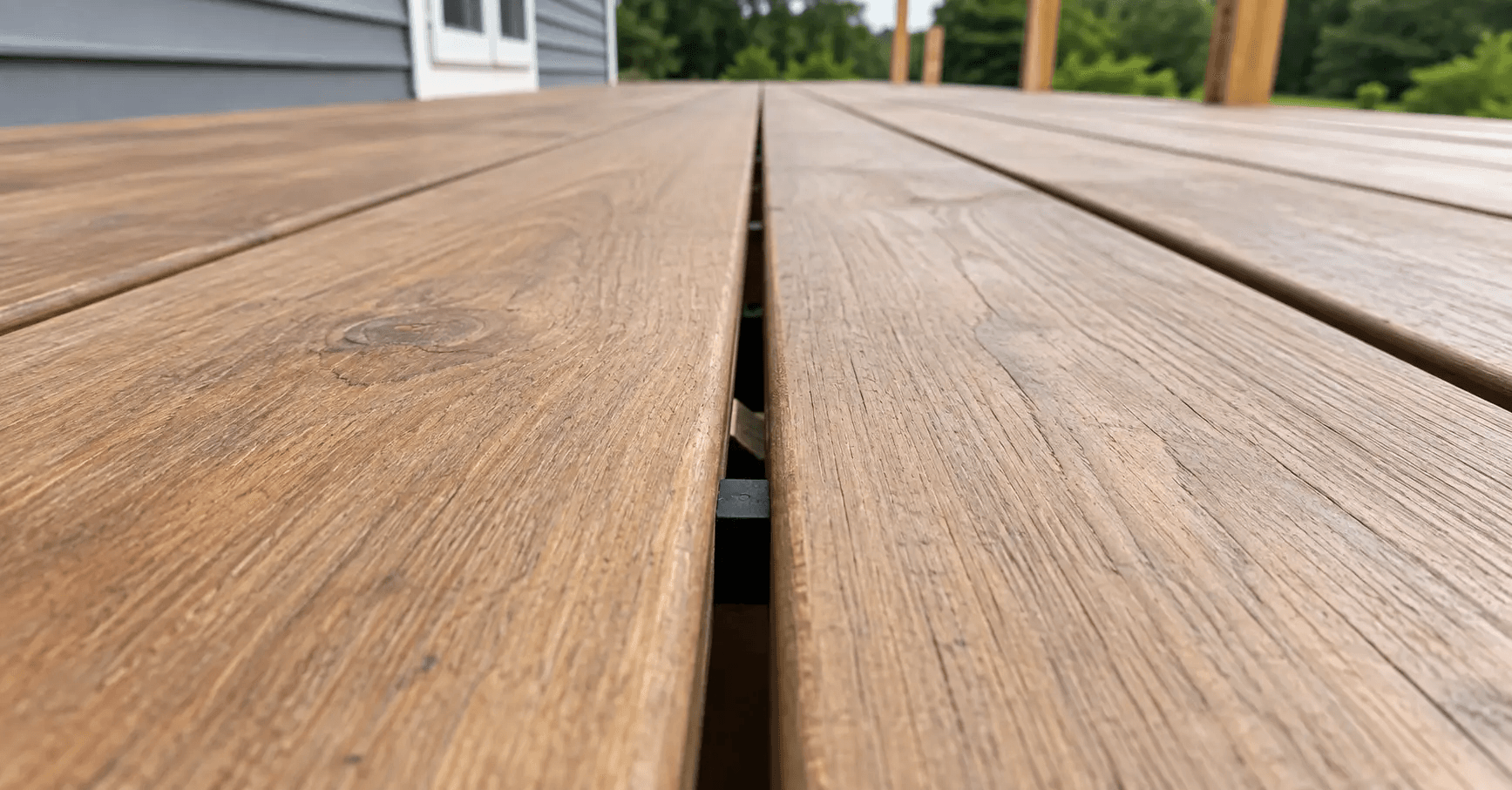
Deck boards move. Wood moves with moisture, composite moves with temperature, and neither one cares what looked right the day you installed it.
Get the gaps wrong and you find out months later. Boards butted tight in spring that cup and pinch by August. Composite installed on a cold day that buckles the first hot week. Gaps packed solid with pine needles that hold water against the framing all winter.
Here is how to gap decking so it still looks right in year three.
Wood: the gap depends on how wet the board is right now
This is the part people get backwards, and it is the single most useful thing to understand about wood decking.
Pressure treated lumber off the rack is usually soaking wet. It was treated with a waterborne preservative and it has not dried out. That board is at its widest right now. As it dries over the first season it will shrink across its width, sometimes noticeably.
So with wet treated decking, you install tight or nearly tight. A gap will open on its own as the boards dry. If you install wet boards with a quarter inch gap because a gap seems right, you end up with half inch canyons by next summer.
Dry decking is the opposite. Kiln dried treated, cedar, or anything that has been stickered and dried is at or near its narrowest. It will take on moisture outdoors and swell. Those boards need a gap at install, commonly around an eighth of an inch, so they have somewhere to go.
The practical test: pick up a board. If it is heavy and feels damp, and the cut end darkens when you cut it, it is wet. Install tight. If it is light and the cut is dry all the way through, gap it.
Do not use a single habitual spacing for every job. The right gap is a function of what the lumber is doing on that particular delivery.
Composite moves with heat, not water
Composite and PVC barely absorb moisture. What they do is expand and contract with temperature, and they do it more than wood does.
That flips the seasonal logic. The board is at its shortest on the coldest day. If you install composite in November in New Hampshire, every board is contracted, and come July it will be longer than it is the day you set it.
Side to side gaps matter, but the one that causes real damage is the end gap where boards butt together or meet a wall, a post, or picture framing. That is where expansion has nowhere to go and something has to give. Buckled boards, popped fasteners, split ends.
Every composite manufacturer publishes an end gap spec that varies with the temperature at install. Colder install, bigger gap. Pull the chart for the actual product line and check the temperature the morning you are laying boards, not the average for the month.
Also worth knowing: dark colors run hotter in the sun and move more than light ones. A dark board on a south facing deck sees a wider temperature swing than the spec chart's typical case.
Gaps have to actually drain
A gap is not only about movement. It is the drainage system for the whole deck.
Water needs to get off the surface, through the gaps, and away from the framing. Too tight and it does not. In a cold climate, water that sits in a packed gap freezes, and freeze-thaw works joints apart and pushes fasteners.
The bigger issue is debris. Pine needles, maple seeds, and leaves pack into a narrow gap and turn it into a sponge sitting directly on top of your joists. That is how you get rot in the framing of a deck whose surface still looks fine.
Two things help. Keep the gap wide enough to shed debris, which is another reason to be careful about installing wet boards absolutely tight with no gap at all. And tell the homeowner the gaps need clearing in the fall, before snow. Most of them have never been told and will assume the deck takes care of itself.
If the deck is under pines or maples, that conversation is worth having on the walkthrough, because a homeowner who blows the deck off every October gets years more out of it than one who does not.
Fastening and how it interacts with movement
Hidden fastener systems that clip into the board edges control side to side spacing for you, which is convenient. What they do not do is control end gaps, and they can restrain a board that wants to move. Follow the system's instructions on end gaps specifically.
Face screwing gives you more control and more visible fasteners. Two screws per joist, held back from the ends and edges enough that they do not split the board. Predrill near the ends of hardwood or dense composite.
Either way, use fasteners rated for treated lumber and exterior exposure. The connection between a board and a joist is wet more often than anything else on the deck.
Picture framing and mitered corners
Picture framing looks sharp and it is a movement trap. A mitered corner is two boards moving in different directions meeting at a joint that has no tolerance in it. When the boards expand, the miter opens or the corner lifts.
If you are picture framing, the perimeter board needs proper blocking underneath, and the end gaps where the field boards meet the frame have to be right, not tight. This is the detail where composite decks in cold climates most often go wrong, because everything was snug in October and there is nowhere for July to go.
Winter maintenance is part of the spec
Deck builders get called back in spring about damage that happened in January, and most of it is avoidable.
Plastic shovel only. Metal blades gouge wood and scratch composite.
Shovel with the boards, not across them. Going across catches edges and fasteners.
No rock salt. Chloride is hard on wood, on fasteners, and on some composite finishes. Calcium magnesium acetate or plain sand is the safer call, and even then check what the decking manufacturer allows.
Do not chip ice off. A spud bar or an ice chipper will find the board every time.
Put this in writing when you hand the job over. It takes one paragraph, it prevents the call, and it makes you look like someone who thought past the last day on site.
The short version
- Wet treated lumber goes down tight, the gap opens as it dries
- Dry lumber gets a gap at install, it will swell
- Composite gaps by temperature, and the end gap is the one that matters
- Colder install day means bigger end gaps
- Dark composite moves more than light
- Gaps are drainage, keep them clear of debris before winter
- Hidden fasteners set side spacing but not end gaps
- Picture framing needs blocking and real tolerance at the miters
- Plastic shovel, with the boards, no rock salt
None of this shows up on the punch list. It shows up two summers later, when the deck either still looks like the day you left or it does not.
That rounds out the sequence: footings, joist spacing and span, the ledger connection, and now the surface. Four details, all of them invisible in the finished photos, all of them the reason a deck is still tight in a decade.