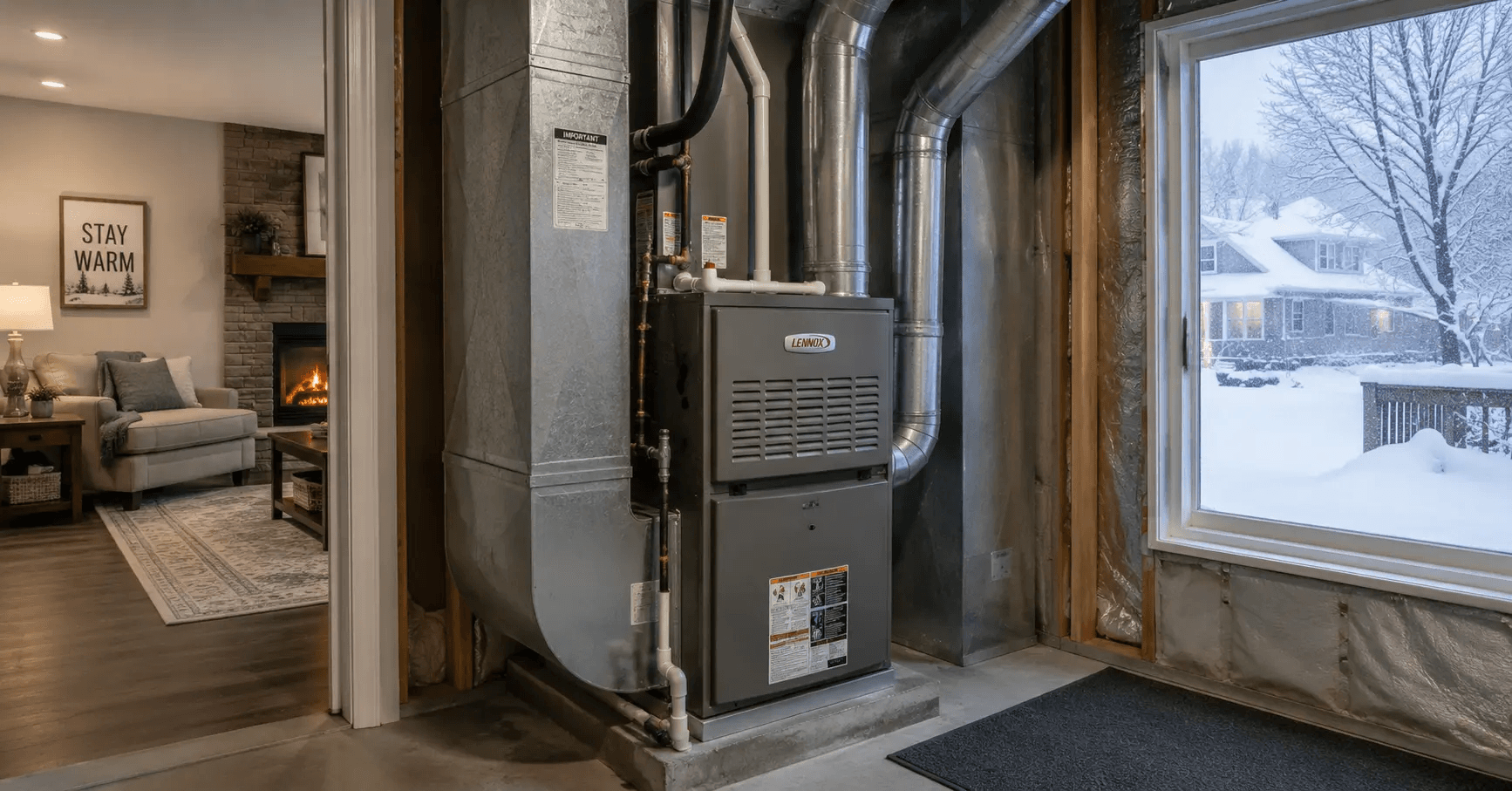
Sizing a heating system comes down to one number: BTUs. Get it right and the home stays warm all winter without wasting energy. Get it wrong and you're either leaving a homeowner shivering on the coldest night of the year or burning through fuel like it's free because the system is oversized and short-cycling.
In cold climates, the stakes are higher. You're dealing with bigger temperature swings, longer heating seasons, and homes that lose heat faster when the wind picks up and the temps drop below zero. The BTU-per-square-foot rules of thumb that work in Georgia don't cut it in New Hampshire.
Here's what you need to know to size it right.
What Is a BTU?
BTU stands for British Thermal Unit. It's the amount of energy needed to raise the temperature of one pound of water by one degree Fahrenheit. In the HVAC world, it's how we measure the heating or cooling capacity of a system.
When someone says a furnace is rated at 80,000 BTU, that means it can produce 80,000 BTUs of heat per hour. The question is whether that's enough for the space it needs to heat, and in a cold climate, "enough" depends on a lot more than just square footage.
If you already know your square footage and climate zone, you can skip the reading and plug your numbers into our BTU calculator to get your answer fast.
The General Rule of Thumb
For heating, the standard starting point is 30 to 60 BTU per square foot, depending on your climate zone. Here's a rough breakdown:
Warm climates (Zone 1 and 2): 30 to 35 BTU per square foot. Think southern Florida, the Gulf Coast, and the desert Southwest. Heating isn't the primary concern in these areas.
Moderate climates (Zone 3 and 4): 35 to 45 BTU per square foot. This covers a big chunk of the country, from the mid-Atlantic through the central states. Winters get cold but they're not brutal.
Cold climates (Zone 5 and above): 45 to 60 BTU per square foot. This is where New England, the upper Midwest, the northern Plains, and mountain regions fall. Long winters, deep freezes, and heating systems that run hard for five or six months straight.
So for a 1,500 square foot home in a cold climate, you're looking at somewhere between 67,500 and 90,000 BTU. For a 2,500 square foot home, that range jumps to 112,500 to 150,000 BTU. These are starting points, not final answers. The real number depends on the specifics of the house.
Why Cold Climates Need More BTUs
The BTU requirement for heating is driven by heat loss. How fast is the building losing heat to the outside? The colder it gets outside, the faster heat escapes, and the harder the system has to work to keep up.
In a cold climate like New Hampshire, your design temperature might be negative 5 or negative 10 degrees Fahrenheit. That means the heating system needs to maintain 70 degrees inside when it's negative 10 outside. That's an 80-degree temperature difference the system has to overcome, compared to maybe a 30 or 40 degree difference in a mild climate.
That alone doubles the BTU requirement per square foot. Add in wind exposure, older construction with less insulation, and the fact that heating season runs from October through April, and you can see why sizing matters so much up here.
Factors That Change the Number
Square footage gets you in the ballpark, but these factors move the number up or down significantly.
Insulation quality. A well-insulated home with modern windows and sealed air gaps can get by with fewer BTUs because it holds heat better. An older home with original insulation, single-pane windows, and drafty doors bleeds heat and needs a bigger system to compensate. The difference between a tightly insulated home and a drafty one can be 20 to 30 percent more BTUs needed.
Ceiling height. Standard BTU calculations assume 8-foot ceilings. If you're working with 9 or 10-foot ceilings, there's more air volume to heat. Bump your estimate up by about 10 to 15 percent for every foot above 8.
Windows. Large windows, lots of windows, or older single-pane windows all increase heat loss. South-facing windows can actually help during the day by letting in solar heat, but north-facing windows are a net loss. More window area means more BTUs.
Number of exterior walls. A room with one exterior wall loses less heat than a room with three. Corner rooms and rooms above garages or unheated spaces need more heating capacity.
Sun exposure. A house shaded by trees or other buildings loses the free solar gain that south-facing homes benefit from. Shaded homes in cold climates need more BTUs, especially during the short winter days.
Basement and foundation type. A slab on grade loses heat differently than a full basement. An unheated basement below the living space acts as a buffer, but a heated basement adds to the total square footage you need to account for.
BTU chart by square footage, cold climate heating
These run at 45 and 60 BTU per square foot, which is the cold climate range from above. Pick the low end for a tight, well insulated house with average ceilings. Pick the high end for an older house, a lot of glass, high ceilings, or anything up north.
| Square footage | At 45 BTU/sq ft | At 60 BTU/sq ft |
|---|---|---|
| 300 | 13,500 | 18,000 |
| 400 | 18,000 | 24,000 |
| 500 | 22,500 | 30,000 |
| 600 | 27,000 | 36,000 |
| 800 | 36,000 | 48,000 |
| 1,000 | 45,000 | 60,000 |
| 1,200 | 54,000 | 72,000 |
| 1,500 | 67,500 | 90,000 |
| 1,800 | 81,000 | 108,000 |
| 2,000 | 90,000 | 120,000 |
| 2,400 | 108,000 | 144,000 |
| 3,000 | 135,000 | 180,000 |
Run your own square footage through the BTU calculator if you want it adjusted for insulation, ceiling height, and sun exposure instead of straight off the chart.
These are heating numbers. Cooling runs lower, usually 20 to 25 BTU per square foot, and the calculator handles both.
Working backwards: how many square feet will a given BTU heat?
Just as often the question comes the other way. You are looking at a unit with a number on the box and you want to know what it will actually cover.
Same math, flipped. Divide the BTU rating by your BTU per square foot figure.
| Unit size | Covers at 60 BTU/sq ft (tough conditions) | Covers at 45 BTU/sq ft (good conditions) |
|---|---|---|
| 9,000 BTU | 150 sq ft | 200 sq ft |
| 12,000 BTU | 200 sq ft | 270 sq ft |
| 18,000 BTU | 300 sq ft | 400 sq ft |
| 24,000 BTU | 400 sq ft | 530 sq ft |
| 30,000 BTU | 500 sq ft | 670 sq ft |
| 36,000 BTU | 600 sq ft | 800 sq ft |
| 45,000 BTU | 750 sq ft | 1,000 sq ft |
| 60,000 BTU | 1,000 sq ft | 1,330 sq ft |
| 80,000 BTU | 1,330 sq ft | 1,780 sq ft |
| 100,000 BTU | 1,670 sq ft | 2,220 sq ft |
One thing worth knowing if you are reading a furnace label. Those ratings are often input BTU, not output. A furnace at 80 percent efficiency rated 100,000 BTU input is putting roughly 80,000 into the house. Check whether the number on the plate is input or output before you size off it, because that gap is the difference between a unit that keeps up and one that does not.
What Happens When You Get It Wrong
Oversizing and undersizing both cause problems, and in cold climates the consequences are worse because the system is working harder and running longer.
Undersized systems can't keep up on the coldest days. The system runs nonstop trying to reach the thermostat setting and never gets there. The homeowner is cold, the energy bills are high, and the equipment wears out faster from running constantly. In extreme cases, pipes can freeze in areas the system can't adequately heat.
Oversized systems have a different set of problems. The system heats the space too fast, shuts off, then kicks back on a few minutes later. This is called short-cycling, and it's hard on the equipment. It also creates uneven heating because the system never runs long enough to distribute heat evenly through the ductwork. An oversized furnace costs more to buy, costs more to run, and doesn't actually keep the home more comfortable.
The sweet spot is a system that runs for extended periods during the coldest weather without running nonstop. If the furnace can maintain temperature on a design-day cold snap while running 80 to 90 percent of the time, it's sized right.
Manual J: The Professional Standard
The BTU-per-square-foot method is a solid starting point for quick estimates and ballpark quoting. But for a final equipment selection, the industry standard is a Manual J load calculation.
Manual J takes into account everything: square footage, ceiling height, insulation R-values, window types and sizes, orientation, air infiltration, duct losses, number of occupants, and your local design temperature. It gives you an actual heat loss number for the specific building, not a range based on averages.
Most HVAC software and load calculation tools do Manual J calculations. If you're an HVAC contractor, running Manual J on every install protects you and the homeowner. It's the difference between "I think this furnace will work" and "I know this furnace is the right size for this house."
For a quick estimate before you get into the full calculation, our BTU calculator gives you a solid starting number that's a lot more accurate than guessing.
Special Situations in Cold Climates
Garages and workshops. Uninsulated garages need significantly more BTUs per square foot because heat escapes through the walls, ceiling, and garage door rapidly. Plan for 40 to 60 BTU per square foot for an insulated garage, and potentially more for an uninsulated one. A lot of contractors are searching for BTU requirements for garages specifically, and the answer is always "more than you think."
Additions and sunrooms. These are tricky because they're often less insulated than the main house, have more glass, and may be on a separate zone. Size the heating for the addition independently rather than trying to extend the existing system. Running a load calc on just the addition is the safest approach.
Old houses. New England is full of homes built before modern insulation standards. Balloon-framed houses from the early 1900s, stone foundations with no insulation, original single-pane windows. These homes can need 50 to 60 BTU per square foot or even more. Don't assume standard numbers for a 100-year-old farmhouse.
Get Your Number
Whether you're quoting a furnace replacement, sizing a boiler, or helping a homeowner understand what their space needs, getting the BTU number right is the foundation of every heating job. In cold climates, there's no room for guesswork.
Plug your numbers into our BTU calculator to get a quick, reliable estimate. It's free, it's fast, and it beats doing the math on a notepad in your truck.