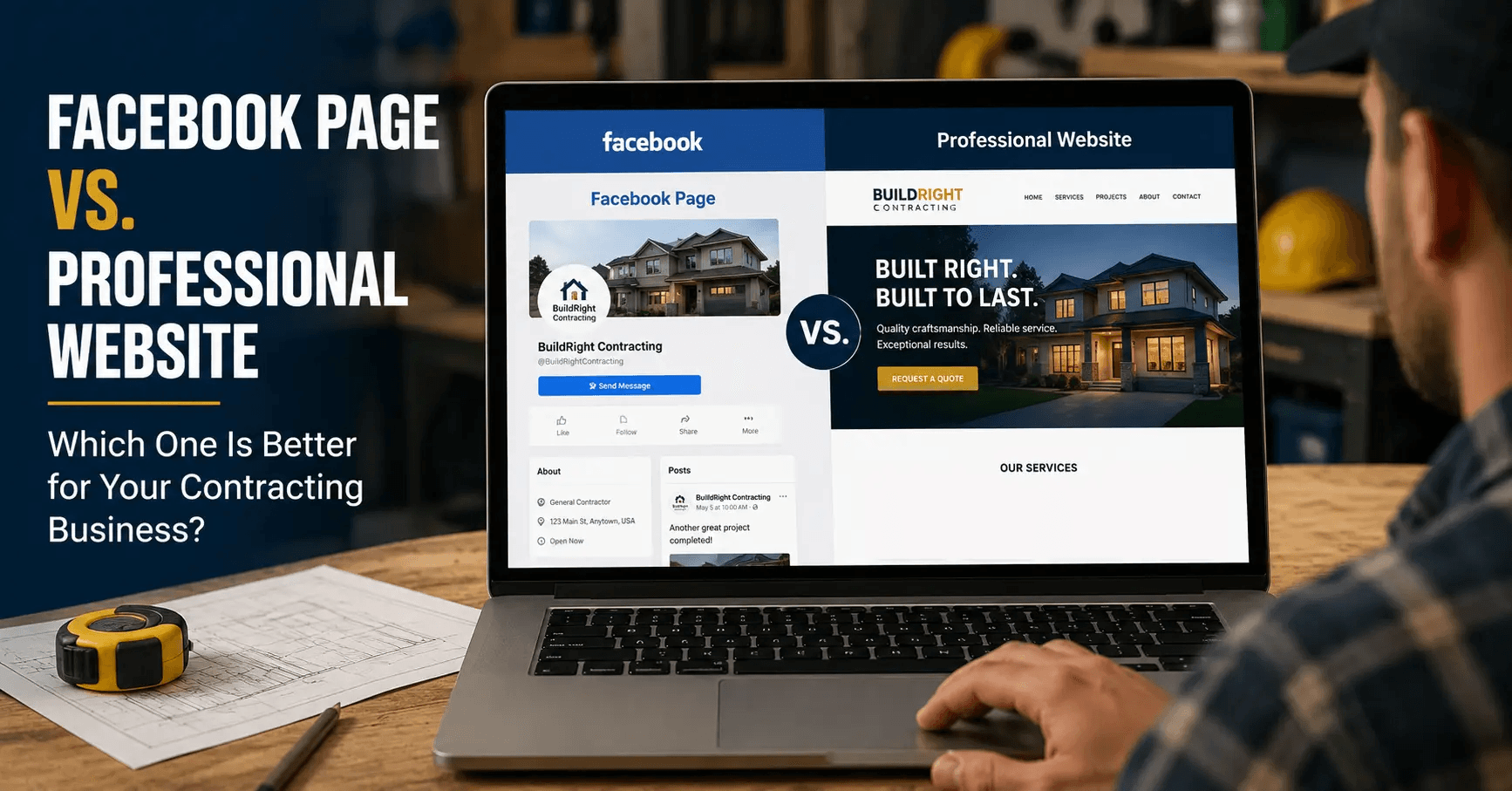
If you ask a contractor where most of their online presence lives, the answer is almost always Facebook. And honestly, that makes sense. It's free, it's easy, everybody's already on it, and you can throw up job photos and get some likes and comments without thinking too hard about it.
But here's the question nobody wants to sit with: is your Facebook page actually getting you jobs? Or does it just feel like it is?
A lot of contractors treat Facebook like it's a website. It's not. It can do some things a website can't, but it also can't do a lot of things a website can. Understanding the difference is the key to figuring out where your time and money should actually go.
What Facebook Does Well
Let's give credit where it's due. Facebook is great for a few things.
It's a good place to show off your work. Before-and-after photos of a deck build, a kitchen remodel, or a new roof get attention. People like them, share them, and tag their friends. That kind of social proof is valuable and it's hard to replicate anywhere else.
Facebook is also solid for staying in front of people who already know you. Your past customers, your neighbors, people who've been following you for a while. When they see your posts pop up in their feed, you stay top of mind. The next time someone asks them "hey, know a good plumber?" your name comes up.
And Facebook groups can be a goldmine for local contractors. Community groups where people ask for recommendations are basically free lead generation if you've built up enough of a reputation.
Where Facebook Falls Short
Here's where things get real. Facebook has some serious limitations that most contractors don't think about until it's already costing them work.
You don't own your Facebook page. Meta does. They can change the algorithm, reduce your reach, suspend your page, or shut it down entirely, and you have zero say in the matter. Contractors have had pages disabled overnight with no warning and no clear reason. If your entire online presence is built on someone else's platform, you're building on rented land.
Facebook doesn't show up on Google. When a homeowner searches "roofer near me" or "deck builder in Manchester NH," your Facebook page is almost never what comes up. Google prioritizes real websites and Google Business Profiles in local search results. If you don't have a website, you're invisible to everyone who searches that way, and that's a lot of people.
Your reach keeps shrinking. Facebook's organic reach for business pages has dropped to somewhere around 2-5% of your followers. That means if you have 1,000 followers, only 20 to 50 of them are seeing your posts. The rest never know you posted anything. Facebook wants you to pay for ads to reach your own audience.
There's no clear path from browsing to calling. A Facebook page doesn't guide someone toward picking up the phone or requesting a quote the way a well-built website does. There's no dedicated page explaining your services, no contact form, no clear call to action. People scroll through your photos and then keep scrolling through their feed. A well-structured homepage is designed to turn that visitor into a call.
What a Website Can Do That Facebook Can't
A website is your home base. It's the one place online that you fully control, and it's built to do one thing: get people to contact you about a job.
It shows up on Google. A website with the right content, structure, and basic SEO in place can rank in local search results and bring in leads from people who don't know you yet. These aren't friends of friends or people in your neighborhood. These are homeowners actively searching for the exact service you offer, right now, in your area.
It works with your Google Business Profile. Your Google Business Profile is what shows up in the map pack at the top of search results. It links to your website. The two work together. Without a website, your GBP is doing half the job it could be doing.
It shows up in AI search. Tools like ChatGPT and Claude are now being used by homeowners to find contractors. These AI tools pull from websites, reviews, and directories to make recommendations. If you don't have a website, you're invisible in AI search the same way you're invisible on Google without one.
It lets you build dedicated pages for every service. A roofer can have separate pages for roof replacement, roof repair, and gutter installation. An electrician can have pages for panel upgrades, rewiring, and lighting. Each page is a new opportunity to rank for a different search term and attract a different customer. You can't do that on Facebook.
It gives you tools that generate leads around the clock. A website can host free calculators and tools that bring in traffic and keep people on your site. A roofing calculator that helps a homeowner estimate their project, a BTU calculator that sizes their heating system, or a fence calculator that tells them how many posts they need. These tools bring people to your site who are actively planning a project, which is exactly the kind of visitor you want.
It builds trust faster. A professional website with Google reviews, photos of your work, your service areas, and your credentials tells a homeowner everything they need to know before they call. A Facebook page can show photos, but it doesn't have the structure to present your business in the most professional and trustworthy way.
The Real Answer: You Need Both
This isn't really a fight between Facebook and a website. The smart move is to use both, but use them for what they're actually good at.
Use Facebook for engagement. Post your job photos, interact with your community, stay visible to people who already know about you. It's great for that.
Use your website for lead generation. That's where strangers find you on Google, learn about your services, read your reviews, and decide to call you. It's the engine that brings in new business from people who have never heard your name before.
When someone sees your work on Facebook and wants to learn more, where do they go? If the answer is "they just scroll through more Facebook posts," you're losing them. If the answer is "they click through to my website where everything is laid out professionally," you're winning.
But I'm Getting Work From Facebook Already
A lot of contractors say this, and it might be true. But think about where those leads are actually coming from. Most of the time, it's referrals that happen to come through Facebook. Someone tags you in a community group post, or a past customer shares your page. That's word of mouth running through Facebook, not Facebook generating the lead.
Now think about all the homeowners who searched for your trade on Google and never found you because you don't have a website. Think about the AI searches where your business wasn't mentioned because there's no website for those tools to pull from. Think about the people who saw your Facebook page, thought it looked a little thin, and called the other guy who had a professional website with reviews and service pages.
Those are jobs you'll never know you lost. And that's the real cost of relying only on Facebook.
Getting Started Doesn't Have to Be Complicated
If you've been running your business off Facebook and the idea of building a website feels overwhelming, it doesn't have to be. You don't need something fancy. You need a clean homepage that says what you do and where you do it, service pages that turn visitors into leads, and a connection to your Google Business Profile.
Not sure where your online presence stands right now? Grab a free website audit and we'll show you exactly where you're losing potential jobs. Or if you're ready to stop building on rented land and get a site that works for you 24/7, check out what we build for contractors.