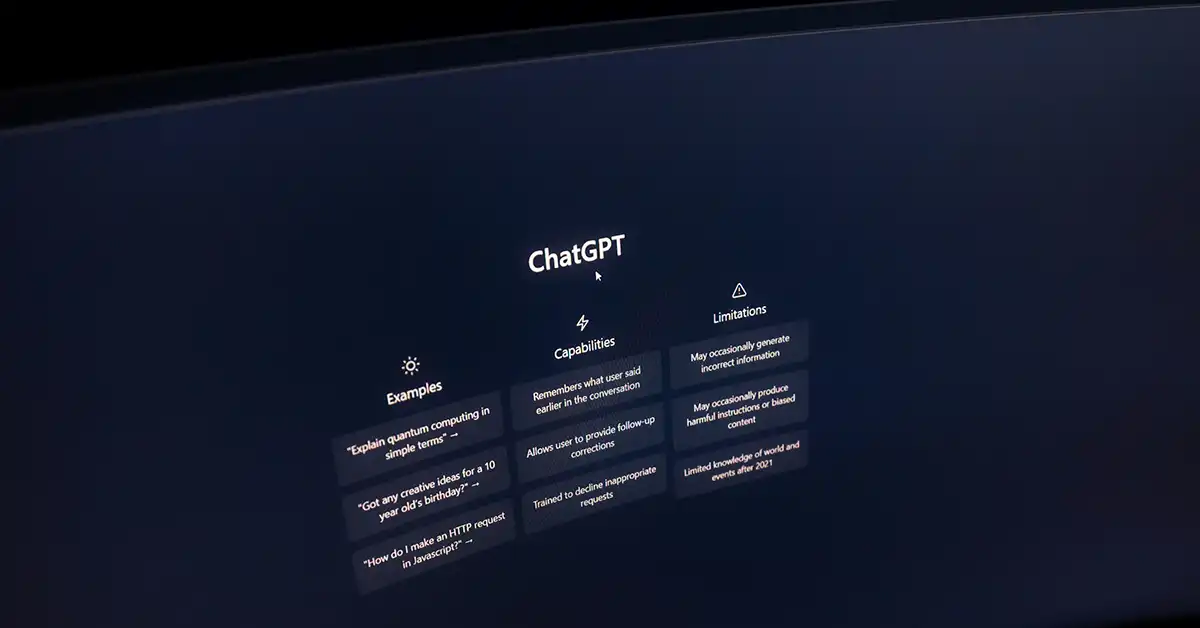
Google used to be the only place homeowners went to find a contractor. That's not the case anymore. More and more people are opening up ChatGPT, Claude, or Perplexity and typing something like "Who's the best roofer in Manchester NH?" or "I need a plumber for a leaky pipe, who should I call?"
And here's the thing. These AI tools don't spit out a list of ten links. They give one answer. Maybe two or three names at most. If your business isn't one of them, you don't exist in that conversation.
This is still early. Most contractors haven't even thought about this yet, which means there's a real window to get ahead. Here's what you need to know.
What Is AI Search and Why Should You Care?
AI search is when someone uses a tool like ChatGPT, Google's AI Overviews, Claude, or Perplexity to ask a question instead of doing a regular Google search. Instead of getting a page full of links to scroll through, they get a direct answer written out for them.
Homeowners are already using these tools to ask things like "How much does it cost to replace a furnace?" or "Who does deck building in Nashua?" If the AI knows about your business and trusts what it finds, it might recommend you by name. If it doesn't know you exist, it'll recommend someone else or just give a generic answer.
The number of people searching this way is growing fast. And it's not just the standalone apps. When you do a normal Google search now, there's often an AI Overview sitting at the very top of the results, answering the question before you ever reach the regular links. That means even your "normal" Google traffic is being filtered through AI. Getting in front of this now, while your competitors are still sleeping on it, is one of the smartest moves you can make.
You Might Hear This Called GEO or AEO
The marketing world has started throwing around some new acronyms, and you'll run into them if you read up on this. It's worth knowing what they mean so you're not confused, though the actual work is simpler than the jargon makes it sound.
SEO, search engine optimization, is the old familiar one: getting found on Google. GEO stands for generative engine optimization, which just means getting found by AI tools that generate answers, like ChatGPT and Perplexity. AEO, answer engine optimization, is basically the same idea, optimizing to be the answer an AI gives.
Don't let the new letters intimidate you. Under the hood, showing up in AI search comes down to the same fundamentals as ranking well on Google, plus a couple of extras. If you do the basics right, you're optimizing for all of it at once.
How AI Decides Who to Recommend
AI tools don't work like Google. They don't crawl a list of websites and rank them by who has the most backlinks. They pull from a huge pool of information across the internet and look for businesses that seem trustworthy, well known, and consistent.
Here's what these tools are paying attention to:
Consistency across the internet. If your business name, phone number, address, and services show up the same way on Google, Yelp, the BBB, Angi, Thumbtack, and your own website, AI tools see that as a sign you're a real, established business. If your info is different in different places, that's a red flag and the AI will skip over you.
Reviews. AI tools lean heavily on businesses with lots of recent, positive reviews. A contractor with a hundred Google reviews and a 4.5 star rating is going to get mentioned before a contractor with eight reviews from three years ago. Recent activity matters just as much as the total count. This is one more reason a steady review habit pays off, since the same reviews that help you in Google's map pack are feeding the AI too.
Content that answers real questions. When a homeowner asks AI "How do I know if my roof has hail damage?" the AI is looking for a clear, helpful answer. If your website has a blog post or FAQ that answers exactly that question in plain language, the AI might pull from your site or even mention your business.
Authority and reputation. AI tools cross-reference a lot of sources. If your business is mentioned on reputable sites, in local news, on industry directories, or in online discussions, that builds trust. The more places your business shows up in a credible way, the more likely AI is to recognize you as a real player in your area.
What an AI Recommendation Actually Looks Like
Let's make this concrete. Say a homeowner in Nashua opens ChatGPT and types "I need a good deck builder in Nashua NH, who should I call?"
Behind the scenes, the AI looks for deck builders associated with Nashua. It checks who has a real, consistent web presence, who has strong recent reviews, and who has content that clearly says they build decks in Nashua. Then it writes something like: "A few well-reviewed deck builders serving Nashua include [Business A], which has strong reviews for custom composite decks, and [Business B], known for..."
Notice what just happened. The homeowner didn't see ten blue links. They saw two or three names, described in a sentence each, presented as a trusted recommendation. If you're one of those names, you just got the warmest possible lead. If you're not, you never had a shot, and you'll never even know the conversation happened. That's the whole game, and it's why this matters even though you can't see it in your normal analytics.
Help the AI Read Your Site: Structured Content
Here's a more technical piece that gives you an edge. AI tools and search engines understand your site better when the information is structured clearly rather than buried in paragraphs.
Two things help a lot. First, a real FAQ section on your pages, with actual questions written the way homeowners ask them and clear, direct answers underneath. AI loves pulling from clean question-and-answer format because it maps directly to how people ask it things. Second, behind-the-scenes structured data, sometimes called schema markup, which labels your business info, services, service areas, and reviews in a format machines read easily. You won't see it on the page, but it tells the AI exactly who you are, what you do, and where.
Most contractors will need help setting up schema, and that's fine. The takeaway is that a site built with clean structure and proper markup has a real advantage in AI search over a site that's just walls of text. It's part of what separates a site built to actually work from one that just sits there.
5 Things You Can Do Right Now
1. Test your AI visibility. Open up ChatGPT, Claude, or Perplexity and ask each one to recommend a contractor in your trade and your city. See if you show up. See who does. This takes five minutes and will tell you exactly where you stand.
2. Clean up your business listings. Go through Google Business Profile, Yelp, BBB, Angi, Thumbtack, and anywhere else your business is listed. Make sure your name, address, phone number, hours, and services are identical everywhere. AI tools cross-check this information, and inconsistencies will knock you out of the running. Start with your Google Business Profile, since it's the anchor everything else gets checked against.
3. Get more Google reviews and get them consistently. Don't just ask for reviews after big jobs. Ask after every job where the customer is happy. Send them a direct link to make it easy. AI tools favor businesses with steady, recent review activity over businesses that got a bunch of reviews two years ago and then stopped.
4. Write content that answers homeowner questions. Think about the questions you get asked all the time. "How much does a bathroom remodel cost?" "How long does it take to replace a roof?" "Do I need a permit for a deck?" Write simple, helpful answers to these questions on your website. Use them as blog posts or FAQ pages. This is exactly the kind of content AI tools pull from when building their answers.
5. Build dedicated pages for every service and location you cover. A page titled "Deck Building in Nashua NH" with real details about what you do, how long it takes, and what it costs is way more useful to AI than a generic services page that lists twelve things with one sentence each. Each page is a new chance for AI to find you and connect you with someone looking for that specific service in that specific area.
The Overlap With Regular SEO Is Your Friend
Here's the good news that ties it all together. You don't have to choose between optimizing for Google and optimizing for AI. Almost everything on that list does double duty.
Consistent business listings help your Google map-pack ranking and your AI visibility. Reviews help both. Question-answering content helps both. Dedicated service and location pages help both. A clean, well-structured, fast website helps both. The same foundational work covered in our guide on what every contractor website needs to rank on Google is the same foundation that gets you picked up by AI. You're not doing two jobs. You're doing one job that pays off in two places.
This Isn't Replacing Google. It's Adding a New Lane.
You still need to show up on Google. That's not going away. But AI search is a second lane that's getting busier every month, and most contractors haven't even noticed it yet.
The good news is that a lot of what helps you rank in AI search also helps you rank on Google. Cleaning up your listings, getting reviews, writing helpful content, and building out service pages are all things that make your entire online presence stronger.
The contractors who start paying attention to this now are going to have a serious head start. The ones who wait are going to wonder why their phone stopped ringing as often.
Not sure how your website is performing right now? Grab a free website audit and we'll show you where you stand. Or if you're ready to build a site that works for both Google and AI, check out what we build for contractors.