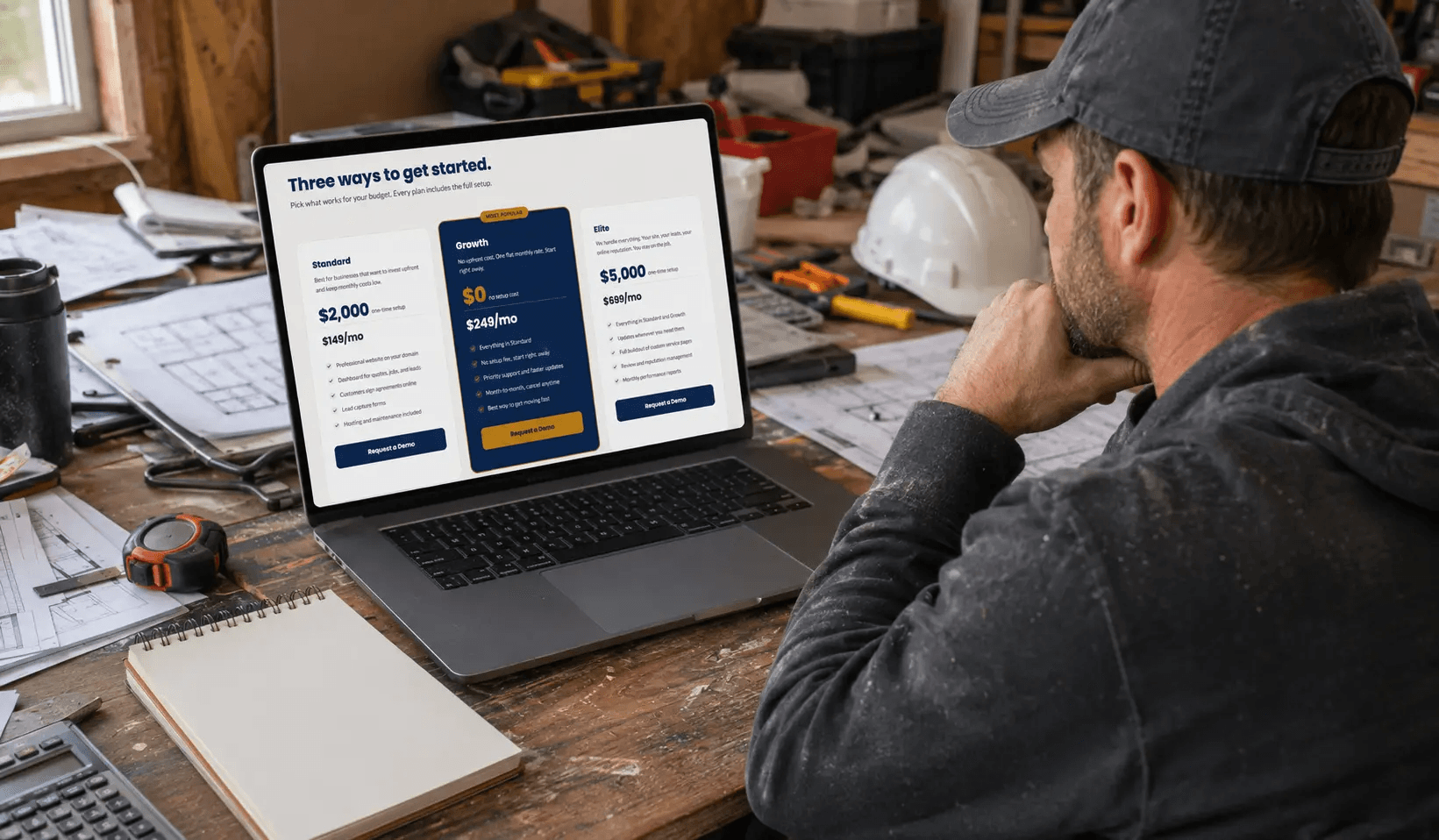
If you've started looking into getting a website for your contracting business, you've probably seen prices all over the map. One guy quotes you fifteen grand. A website builder ad says sixteen bucks a month. Your nephew says he'll do it for free over a weekend. So what's the real number? What should you actually pay?
The honest answer is that it depends on what you need and who builds it. But that's a cop-out answer, and you came here for real numbers. So let's break down every option, what it actually costs, and what you get for the money, so you can make a smart decision instead of guessing.
The Quick Answer
For a professional contractor website that actually brings in leads, you're generally looking at one of two structures. Either a one-time build cost somewhere between $1,500 and $5,000, or a monthly subscription that bundles the build, hosting, and maintenance together, usually somewhere from $100 to $300 a month, sometimes with a setup fee on top.
That's the range for a real site that gets found on Google and turns visitors into phone calls. Not a bargain-bin digital business card that just sits there, and not an overpriced agency build loaded with stuff a contractor doesn't need. Let's look at each option so you can see where that range comes from.
Option 1: Do It Yourself (Wix, Squarespace, GoDaddy)
What it costs: Roughly $15 to $40 a month for a plan with hosting, a domain, and templates.
What you get: A template you build and maintain yourself. You pick a design, swap in your own photos and text, and publish it.
On paper this looks like the cheapest option. In reality it's often not, and here's why. The real cost is your time. Most contractors who go this route spend ten to twenty hours fighting with the template trying to make it look right, and a lot of them still aren't happy with the result. If you bill $75 an hour on a job, that's over a thousand dollars of your time spent on a website that probably still doesn't rank on Google or convert visitors well.
The other catch is that DIY builders are built for everybody, which means they're built for nobody in particular. They don't know anything about contractors, local SEO, or what makes a homeowner call you. You end up with a generic site that looks like a template because it is one.
DIY can make sense if you're brand new, dead broke, and just need something basic online while you get going. But it's a starting point, not a real lead generator.
Option 2: A Cheap Freelancer
What it costs: Anywhere from $300 to $2,000 depending on where you find them.
What you get: A custom-ish site someone else builds and hands off to you. Quality is a total tossup.
This is the wild west. You can find a freelancer on an overseas marketplace for a few hundred bucks, or a solid local freelancer for a couple grand. The cheap end is risky. The site might look okay but not show up on Google, not work right on phones, or not bring in a single lead. And if they're overseas or hard to reach, good luck getting changes made after launch.
A good local freelancer who understands contractors can be a solid middle-ground choice. The trouble is telling the good ones from the bad ones before you've paid. We covered exactly what to look for in our guide on how to pick the right web designer, and it's worth reading before you hire anyone in this category.
Option 3: A Custom Agency Build
What it costs: $5,000 to $15,000 or more for the build, plus $200 to $500 a month for hosting and support.
What you get: A fully custom website with professional design, copywriting, and ongoing support.
This is the high end. A good agency will interview you, write custom copy, design everything from scratch, and build a real strategy around your business. The result can be excellent. The downside is the price, and the fact that a lot of what agencies charge for is stuff a typical contractor doesn't actually need.
Unless you're a big operation with multiple locations and a serious marketing budget, a fifteen-thousand-dollar custom build is usually more than a contractor needs. You're paying for a level of customization that doesn't move the needle on getting more roofing or plumbing jobs. The basics, done well, get you most of the way there for a lot less.
Option 4: A Done-For-You Contractor Website Service
What it costs: Typically a setup fee plus a monthly rate, or just a flat monthly subscription. Often in the range of $150 to $300 a month, sometimes with a setup fee.
What you get: A professional site built specifically for contractors, with hosting, maintenance, updates, and lead tools all handled for you.
This is the option that fits most contractors best, and it's worth explaining why. Instead of paying one big lump sum and then being on your own, you get the whole thing handled on an ongoing basis. The site gets built, hosted, maintained, and updated, and you don't have to touch any of the tech. The people building it already understand contractors, so you're not paying them to figure out your business on your dime.
Because it's built on proven structures rather than designed from a blank page every time, you skip the expensive custom-design stage but still get a site that's built to convert visitors into leads. You get the structural know-how without the agency price tag. And the monthly model means it includes the ongoing stuff that DIY and one-time builds leave you to deal with yourself.
Why There's a Setup Fee and a Monthly Fee
A lot of contractors get tripped up by the two-part pricing. Here's the simple way to think about it. The setup fee covers building the site. The monthly fee covers keeping it running, secure, updated, and improving over time.
Think about it like your truck. You pay for the truck up front, then you pay for oil changes, insurance, and tires to keep it running. Skip the maintenance and the truck breaks down on you. A website is the same. The build gets it on the road. The monthly keeps it running and working. A site nobody maintains slowly breaks, falls out of date, and drops down in Google.
What Actually Drives the Price Up or Down
Whatever route you go, a few things move the number.
Number of pages. A simple five-page site for a one-trade operation costs less than a fifteen-page site covering four services across a dozen towns. More pages, more work, higher cost. But more pages also means more chances to rank on Google for different searches, so it can be worth it.
Custom design versus proven templates. Fully custom design from scratch costs the most because every decision starts from a blank page. A proven template customized for your business costs less and often performs just as well, because the hard structural decisions are already battle-tested.
SEO and lead tools. A basic brochure site costs less than one built with local SEO, lead capture forms, and quote tools baked in. But the brochure site won't bring in work, so the cheaper option is usually the worse value.
Ongoing support. A site you're left to maintain yourself costs less up front than one where someone handles everything for you. You're trading money for time either way.
How to Think About the Cost
Here's the mindset shift that makes all of this clearer. Don't ask "what's the cheapest website I can get." Ask "what's a website going to bring back to my business."
A single job from a website lead usually pays for the entire year of website costs. One roof replacement, one kitchen remodel, one HVAC install booked through your site covers the investment several times over. We ran the full math on this in our post on the real cost of not having a website, and it's the same logic here. A site that costs more but brings in steady work is a far better deal than a cheap one that brings in nothing.
The expensive mistake isn't paying for a good website. It's paying for a cheap one that doesn't work, or paying nothing and staying invisible while your competitors get the calls.
The Bottom Line
For most contractors, a real lead-generating website lands somewhere in the range of $1,500 to $5,000 as a one-time build, or roughly $150 to $300 a month for a done-for-you setup that includes hosting and maintenance. DIY builders are cheaper but cost you time and rarely generate leads. Big agency builds can run five figures and are usually more than a contractor needs.
The right number for you depends on what you need the site to do and how much of the work you want to handle yourself. But whatever you choose, judge it by what it brings back to your business, not just the sticker price.
Curious what a contractor website actually costs and includes? See our pricing, take a look at what we build for contractors, or grab a free audit of your current site.