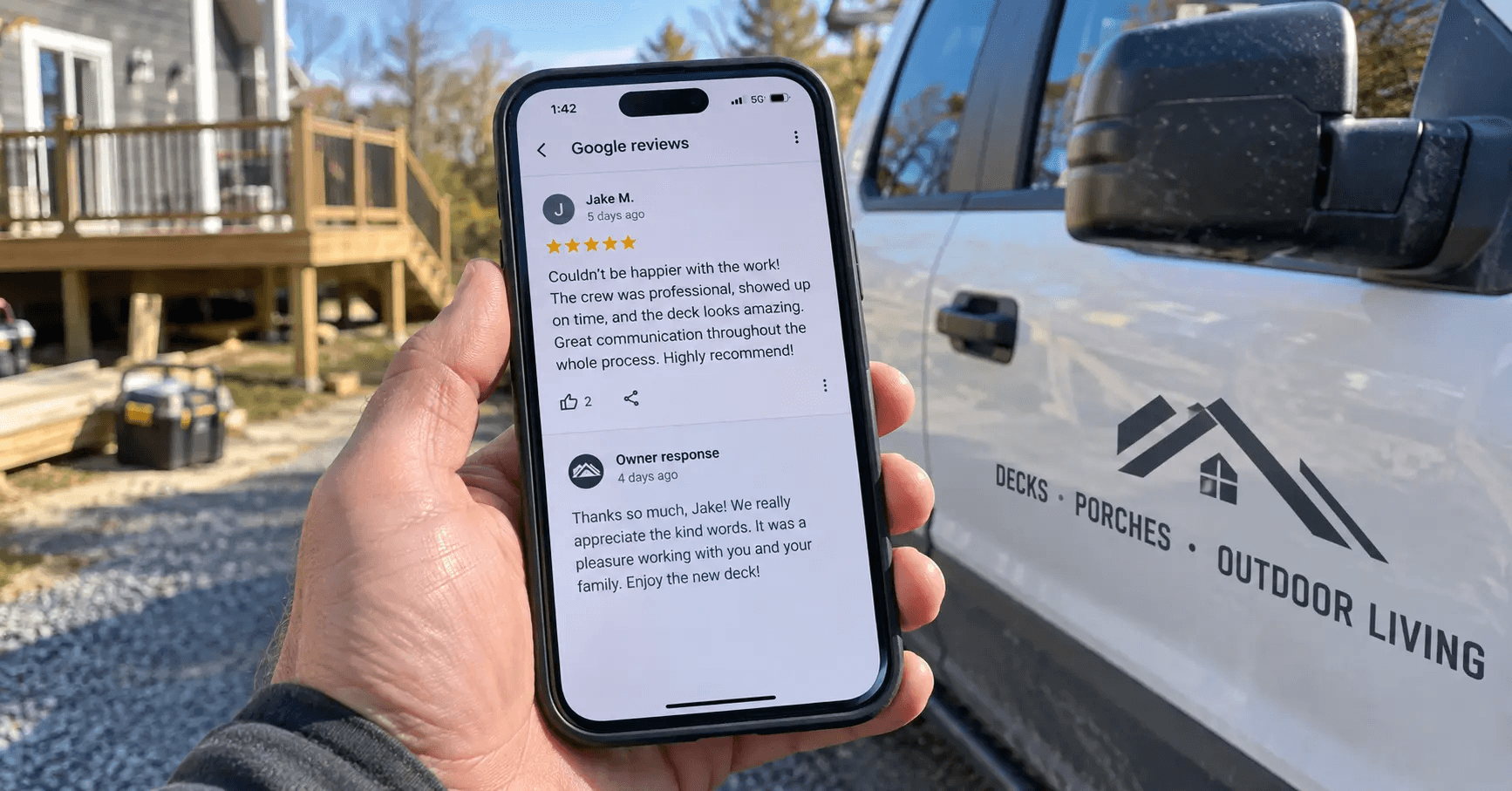
Getting reviews is half the job. What you do underneath them is the other half, and it is the half most contractors skip.
Here is the thing people miss. Your responses are not for the person who wrote the review. That customer is done, paid, and gone. Your responses are for the homeowner reading your profile six months from now, deciding between you and two other guys. They are going to read the worst review you have and then look straight at what you said back.
That reply is a work sample. Treat it like one.
Reply to every single one
Good, bad, and the two word ones that just say "great job." All of them.
Two reasons. A profile where every review has an owner response reads like a business somebody is actually running. A profile where only the angry ones got a reply reads like a business that shows up when it is cornered.
And Google has said outright that responding to reviews is a signal it pays attention to. It is not a huge ranking lever by itself, but it is free and it takes two minutes.
Set a rhythm. Friday afternoon, go through whatever came in that week. If you wait until you feel like it, you will have four months of unanswered reviews and a profile that looks abandoned.
Good reviews: say something specific
"Thanks for the review!" on every single one is barely better than nothing. It reads like a template, because it is one.
Name the job. "Thanks Dave. That back deck came out great, and those stairs down to the yard were the right call." Fifteen seconds of effort and now the reply is doing work for you.
Specific replies do two things a generic one cannot. They prove a real person from your company is typing, not a service. And they quietly put the job type and sometimes the town into your profile text, written naturally, where somebody skimming your reviews will see the kind of work you do.
Do not stuff keywords. "Thanks for choosing our Manchester NH roofing contractor services" is obvious to every human who reads it and makes you look worse than saying nothing. Write like you talk.
Bad reviews: the shape that works
First, wait a day. Nobody has ever written a better reply while still hot about it. The review is not going anywhere.
Then keep it short. Four sentences is plenty, and there is a reason for that. A long reply looks defensive no matter how reasonable the content is. The reader has not read the whole thing. They have glanced at it and formed an impression from the length and tone alone.
The structure that works:
Acknowledge it. Not a fake apology, just recognition that they had a bad experience. "Sorry the schedule slipped on your job."
One line of context, no argument. If there is a fact worth stating, state it once and flatly. "We hit two weeks of rain in October and I should have called you sooner about it."
Take it offline. "Give me a call at the office and I would like to make it right." Your number, not a support portal.
Stop. Do not add a closing paragraph about how much you value quality.
What you are showing the future reader is that when something goes wrong, you own it and you pick up the phone. That is worth more than a clean five star average, because nobody believes a clean five star average anyway.
What not to do, ever
Do not argue the facts point by point. You might be completely right. It does not matter. The guy reading it does not know either of you and a long rebuttal makes you look like the difficult one.
Do not mention what they paid or what they owe. Bringing money into a public reply looks petty and can cross a privacy line.
Do not share job details they did not share. Their address, their health, their divorce, why the project was delayed on their end. You will feel justified and you will look terrible.
Do not respond twice. If they reply to your reply, let it go. Nobody wins a thread.
Do not ask them to take it down in the public reply. If you fix the problem, they often take it down on their own. Asking publicly makes the whole thing about the review instead of the customer.
Reviews that are not from your customers
Sometimes a review is not a bad review. It is a wrong one.
A competitor, a case of mistaken identity, a guy you turned down for a job, someone confusing you with another company with a similar name. It happens more than people expect.
You can report these through your Google Business Profile for policy violations. Fake engagement, off topic content, conflict of interest, and harassment are all grounds. Be realistic about the odds. Google removes some of them and leaves plenty of others, and the process is slow.
Reply publicly in the meantime, and keep it calm and factual. "We do not have a record of doing work for you and I think this may be meant for another company. Happy to sort it out, give me a call." That reply does the job whether or not Google ever acts, because the reader can see what happened.
What you should not do is leave it sitting there unanswered while you wait on a removal request that may never come.
The one that is actually your fault
Every contractor gets one eventually. The job that went sideways, the thing you should have caught, the callback you did not return.
Own it plainly. "You are right. We should have come back out and we did not. That is on me." No explanation, no context, no softening.
Counterintuitive, but a straight admission on a genuinely earned bad review does more for your profile than four generic five stars. Homeowners are braced for a contractor who deflects. One who says "that was my fault" reads as unusual, and unusual is what gets remembered when they pick up the phone.
Turn the good ones into something
A strong review is content you did not have to write. Use it.
Pull the best three or four onto your website, with the name and star rating, where visitors actually see them. Screenshot one for a profile post. Put one next to the matching job photos.
The ones worth pulling are specific. "They showed up when they said they would and cleaned up every day" beats "great work, highly recommend," because the first one is answering a question the reader already has.
If you need a system for collecting them in the first place, that is covered in getting more Google reviews without being annoying about it. And the reviews sit on your profile, so how that profile is set up decides how many people ever see them. That is the profile setup piece.
The short version
- Reply to every review, on a set day each week
- Write responses for the next customer, not the one who left it
- Name the specific job in good replies, do not stuff keywords
- Wait a day before answering a bad one
- Four sentences: acknowledge, one line of context, take it offline, stop
- Never argue point by point, never bring up money, never share their details
- Report fake reviews but reply to them anyway while you wait
- On the ones you earned, just say it was your fault
- Pull your best reviews onto your site
Nobody expects a perfect record. What they are reading for is what you do when it is not perfect, and you get to write that part yourself.